Article
6 min read
Why payments needs applied AI
We need SLMs steering LLMs to build new payment flows


We once trusted humans to type payments over telex. Then we built engines and measured STP. Now we have AI – is it time for a new metric?
This article is an edited version of the talk “From Telex to Built-by-AI (BBai)” by Oliver St-Clair Stannard, which was originally delivered on day two of Sibos 2025 at the Discover Stage.
Many of us (me included) have never heard the sound of a bank’s back office before the age of the internet.
I’m told it was the clatter of keys, the whirr of the printer, the hushed folding of warm paper. That was the soundtrack of payments—manual, human, line by line—typed individually into telex machines.
Each payment was a little act of faith: type the beneficiary name, amount, currency, test key… press “send”… and hope no one mistyped a digit.
Volumes grew, and so did the stakes. Errors became expensive.
As an industry, we did something. We took the human bottleneck out, and we built payments engines.
We began to measure ourselves with a new metric—STP, straight-through processing.
We redesigned processes, standardized payments messaging across the world, and codified validation and remittance. Today, many banks operate at near-100% STP for standard flows (or so we’re led to believe).
Millions of payments, billions of dollars, zip through untouched by human hands every day. Compared to telex, it’s unrecognizable.
So what drove this change?
And yet when it comes to modernizing our payment systems, rails, platforms, gateways–updating, upgrading, maintaining–we are stuck in the telex era.
If we look closely at the way change gets made in most institutions – it’s armies of analysts reading rulebooks and writing requirements; engineers deciphering legacy code; architects drawing complex flows; testers writing scenarios; PMOs collecting sign-offs; someone reconciling it all in spreadsheets. End-to-end, it’s almost 100% manual.
But, today, we can see the same three conditions that forced payments to evolve to STP are all here again:
So, is it time for a new metric?
Something that measures by how much this technology is changing how we deliver change? Something that goes beyond STP?
We call it Built-By-AI, or BBai for short (which I think sounds like a droid from Star Wars). You can think of it as software STP.
BBai asks a simple question:
“What percentage of your system change—requirements, mappings, tests, and code—was generated by AI and accepted by humans?”
This is the same arc we’ve already lived through: from telex to payments engines; from high-touch transactions to STP.
Now we go from high-touch documentation to Built-By-AI.
Let’s dig a little deeper.
Think of a bank as running two factories:
We industrialized the first factory. We still handcraft the second.
Now, imagine if your transaction factory still relied on clerks retyping each payment every morning. It’s unacceptable in today’s world.
Yet we still accept similar manual work in the change factory: copying requirements into JIRA, reformatting rulebooks, rekeying test cases, reconciling repositories with code comments.
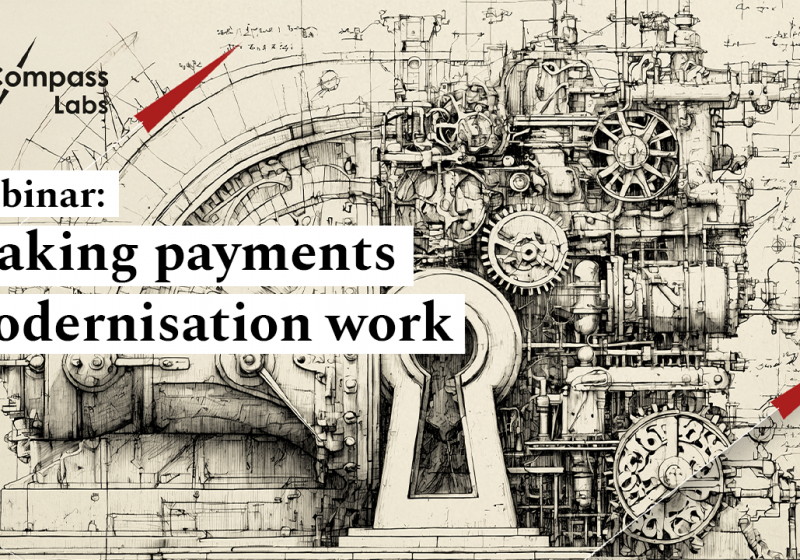
It’s no wonder transformation costs more than expected, lands later than promised, and often fails completely. In fact, nine out of ten (87%) payments modernization projects go over budget, and over eight out of ten (83%) are delayed and not delivered to the original specification.
One of the major reasons is the scarcity of experts who really understand these payment systems, how they’re configured at the bank, and how they can be updated for the modern payments world.
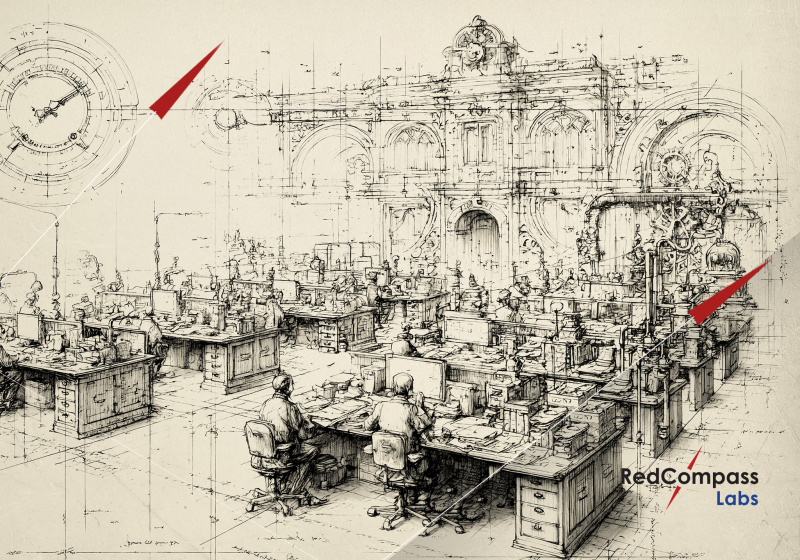
Around half of banks have delayed or scaled back a payments project for this reason.
In highly regulated environments, no matter how fast the technology is evolving, humans still need to decide, review, sign off and ultimately take accountability.
The AI industry is aligned that human-in-the-loop is necessary in high-stakes applications like payments. We go a step further and say there must be an expert-in-the-loop.
The heavy lifting—the typing, reconciling, reformatting—shifts to the machines.
It’s important that we measure the impact of AI on our modernization programs. Without a concrete metric, and a way to track that metric, we cannot separate the value of automation from the human process.
It creates a shared way to measure progress and efficiency gains and set expectations with management, clients, and partners.
Over time, BBai will help demonstrate how the hybrid intelligence model—humans and AI working together—can shift critical work from fully manual to AI-assisted, while allowing us to track progress toward that goal.
There are a few ground rules:
This gives you a defensible metric you can take to your CIO, your auditors, and your board. It’s a baseline. It will get better.
We can’t talk about AI without addressing safety.
AI can’t replace accountability in change processes. It expands capacity and improves consistency, but your controls—peer review, segregation of duties, testing—remain.
You must treat prompts and outputs as you would code. They are your IP.
Version your models and prompts; re-run critical mappings on model upgrades; preserve provenance for every artifact
Regulators care about outcomes and controls. If you can show traceability from rule to evidence with fewer manual errors, you’re moving toward—not away from—compliance.
BBai is about systematising the boring, error-prone work so humans can focus on intent, edge cases, and design.
So, let’s do an experiment:
And give your teams a bold but credible target: BBai 10% in 12 months, 30% in 24 months, 70% in five years.
We once trusted humans to type every payment over telex. Then we built engines and measured STP. Today, we trust machines to move vast amounts of money with no human involvement, at scale, with astonishing reliability.
But in the place where we change those systems, we’re still living in the telex age—manual, slow, error-prone.
We have the opportunity to automate the change factory with the same conviction we brought to automating the transaction factory.
The guiding metric of the new era is Built-By-AI. Not “AI instead of us,” but “AI alongside us,” with humans deciding, supervising, and signing off. The future we want is one where modernization is as automatic as settlement, as measurable as STP, and as safe as the systems we already trust with trillions.
In other words: let’s retire the telex—twice.
Speak to RedCompass Labs. Let’s chat about hybrid intelligence and the future of payments. Learn how you can use human expertise and AI to deliver change for your organization.
*To be clear, this isn’t about blame. Running 24/7 international platforms under heavy regulation and constant change is among the hardest jobs in financial services—the people doing it are world-class; our aim is to help them modernize safely.
Share this post

Oliver St-Clair Stannard
Strategy and Go-to-Market, RedCompass Labs
We need SLMs steering LLMs to build new payment flows

What vendors, banks and systems integrators must do next

Nobody wants to say it: payments complexity exceeds...
Institutions have a short window to get ahead of market, technological and regulatory changes

Payments modernization is still manual. AI can change that, but only if we can prove it
Most payments modernization projects overrun, go over budget, and fail to deliver to the original spec.
Over half of banks have delayed or scaled back a project.

The articles you read, shared, and talked about most this year
Payments are evolving faster than many banks can respond

The gap between what banks need and what their payments platform delivers
Why does this happen?

From Open Banking and stablecoins to fair fees and faster access
The payments modernization is plagued by four systemic issues.