
Article
6 min read
Why payments needs applied AI
We need SLMs steering LLMs to build new payment flows


Over half of banks have delayed or scaled back a project due to expertise gaps. Can AI help?
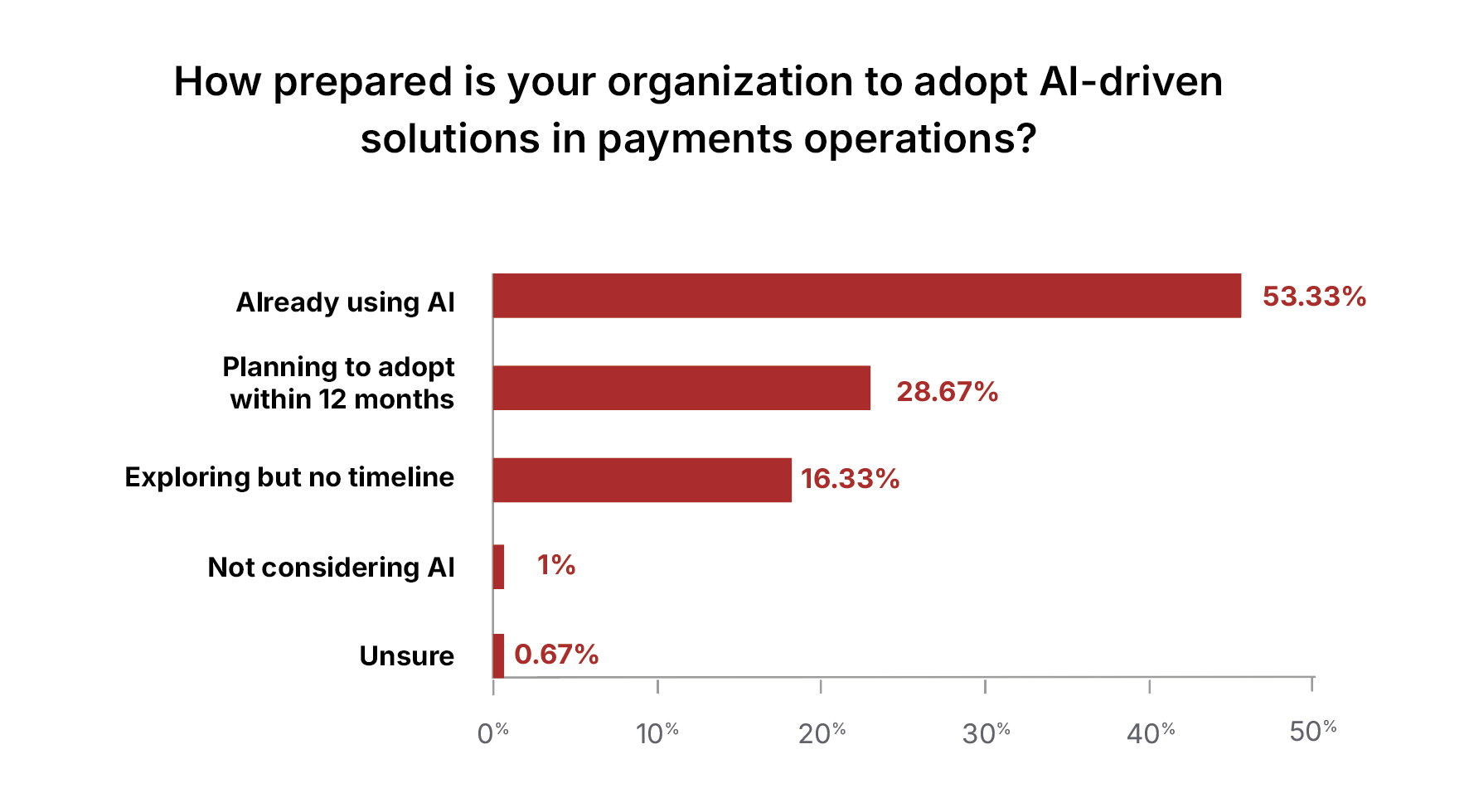
Nearly three-quarters of US payments professionals believe AI agents could help address the shortage of payments expertise. That’s according to a RedCompass Labs survey of 300 US senior payments practitioners.
The report, Payments Modernization: On time, on budget and other fairy tales, digs into the reason most payments modernization projects are not delivered on time, on budget, or to the original spec.
The remainder of the respondents said they might consider adopting AI in the future. Very few ruled it out entirely.
This comes as more than half (55%) of banks say they have delayed or scaled back payments projects because they didn’t have the right people or skills available. Smaller banks are affected slightly more than large banks, but this is not limited to one segment of the market.
Given a market-wide shortage of payments expertise, this isn’t a problem that can be solved simply by hiring more people. Instead, banks need ways to scale and share the expertise that already exists.
This is where a combination of human expertise and applied artificial intelligence can make a real difference.
AI should not replace payments experts. Instead, it can act as a force multiplier — capturing institutional knowledge, surfacing insights, and making specialist expertise accessible to more people across an organization.
By combining the judgment and experience of domain experts with the speed and scalability of AI, banks can onboard new schemes faster, reduce their reliance on scarce talent, and make more consistent decisions.
In this model, AI is not the solution on its own. It’s a strategic enabler that helps banks keep pace with a rapidly changing payments landscape.
Banks are also clear that generic AI tools are not sufficient for payments work. In high-impact workflows, errors can be costly, so AI outputs must be grounded in curated payments knowledge and delivered through controlled workflows.
In practice, this often means bounded agentic systems: agents can analyse, draft, and propose actions using approved tools and sources. Execution is gated by policy checks, testing, monitoring, and human approval. Security and risk frameworks for agentic systems are also maturing, reinforcing the need for guardrails as a core design requirement (not an afterthought).
What banks need is applied AI: systems fine-tuned with payments expertise, grounded in curated payments knowledge (via retrieval) and combined with workflow controls, evaluation, and governance aligned to banking risk standards.
To understand this, think about how most successful organizations operate. Whether it’s a bank, a vendor, or a consultancy, there are usually one or two true experts — the people everyone turns to when faced with a really difficult payments problem. These experts have decades of experience, deep contextual understanding, and an ability to see connections that others miss.
If that expertise can be captured, structured, and combined with a curated corpus of payments standards, bank policies, and delivery artefacts, AI can make it available on demand. Teams could access expert-level guidance at any time, even when the human expert is unavailable. The expert still oversees, guides, and refines the system, but their knowledge scales far beyond what one person could deliver alone.
This is the future of payments modernization: hybrid intelligence, where human expertise and AI work together.
Many banks are already using AI in their payment operations or plan to adopt it soon.
However, 95% of enterprise AI projects fail, often because organizations try to build solutions in-house without the right expertise. Research shows that projects are far more successful when organizations partner with specialists.
This helps explain why banks are becoming more cautious about traditional, large consulting firms. While these firms bring strong brands and delivery frameworks, many banks feel they lack deep, domain-specific payments expertise. Some banks say the advice they receive feels generic, others say there is a lot of talk about AI but limited real impact, and some are concerned about overreliance on junior or generalist teams.
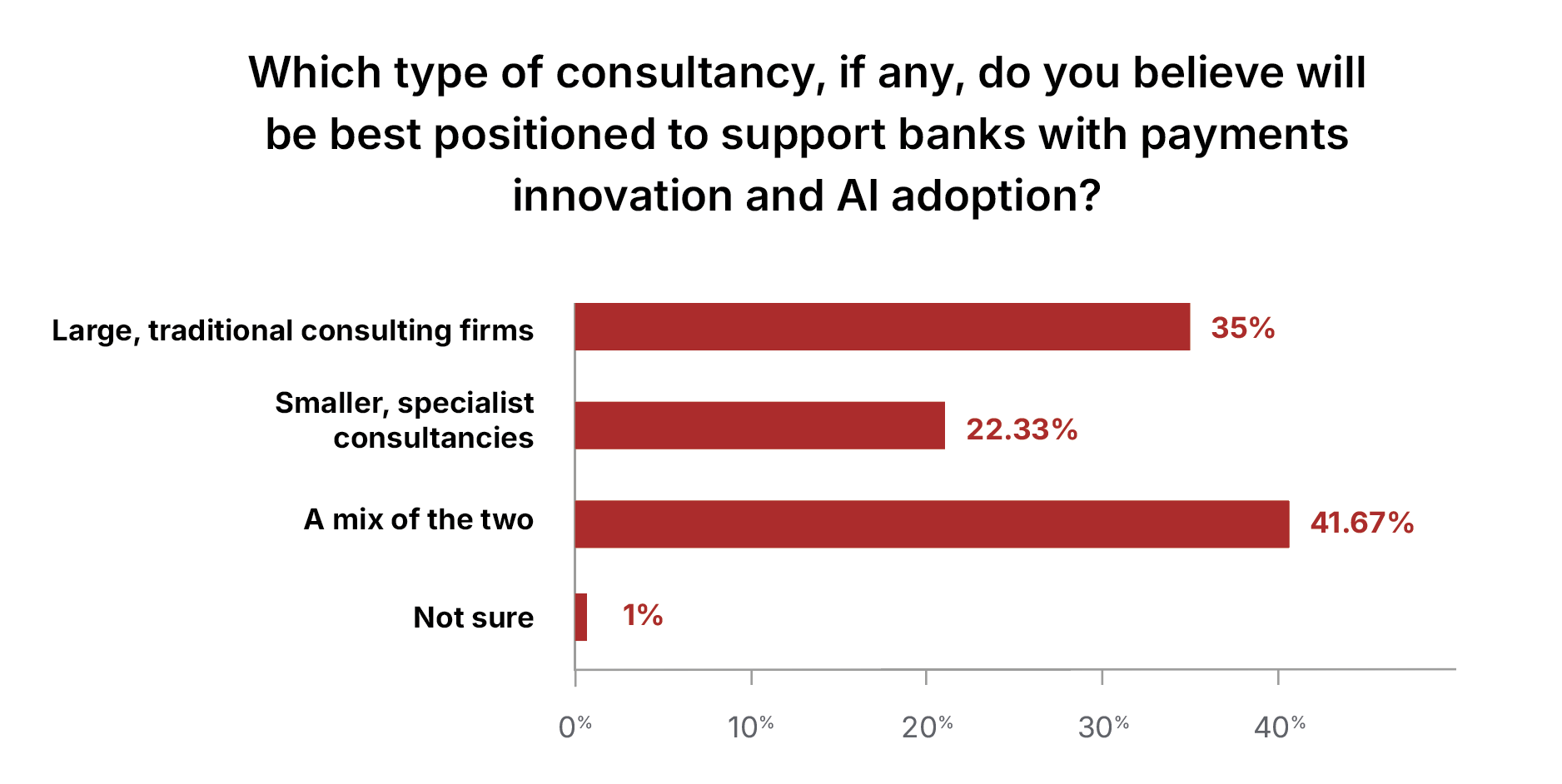
As a result, many banks we’ve spoken to want more demonstrable, domain-specific impact from traditional consulting approaches—especially where AI claims outpace delivered outcomes.
Specialist consultancies are increasingly seen as better positioned to support payments innovation.
Specialists work closely with banks to untangle legacy systems and understand how changes ripple across complex payments environments. They know the schemes, the regulations, and the practical realities of modernisation. Banks recognise this value, and many plan to work with specialist firms — either on their own or alongside larger consultancies.
AI will not replace payments expertise. But it can make that expertise more accessible, more scalable, and more impactful. With the right specialist partners, banks can close today’s capability gaps and position themselves to lead the next phase of payments modernization.
We’ve published a range of resources explaining how you can use applied AI to modernize faster. Click here to access them.
Share this post

Oliver St Clair-Stannard
VP of Payments AI Strategy and Go-to-Market, RedCompass Labs
We need SLMs steering LLMs to build new payment flows

What vendors, banks and systems integrators must do next

Nobody wants to say it: payments complexity exceeds...

Here's how we helped one major North American financial institution
Institutions have a short window to get ahead of market, technological and regulatory changes

Payments modernization is still manual. AI can change that, but only if we can prove it
Most payments modernization projects overrun, go over budget, and fail to deliver to the original spec.

The articles you read, shared, and talked about most this year
Payments are evolving faster than many banks can respond

The gap between what banks need and what their payments platform delivers

Why does this happen?
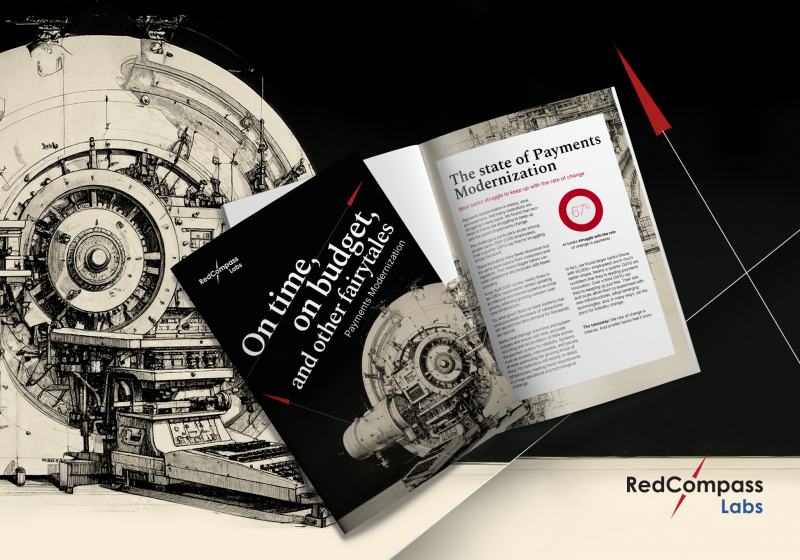

From Open Banking and stablecoins to fair fees and faster access

We once trusted humans to type payments over telex.
The payments modernization is plagued by four systemic issues.