
Article
6 min read
Why payments needs applied AI
We need SLMs steering LLMs to build new payment flows


Here’s how we helped one major North American financial institution
Client: A large North American financial institution (FI)
Sector: Payments of every kind: high-value, cross-border, real-time and batch
SR 2026 address changes impact: adherence to structured or hybrid address; additionally richer party and bank data, enhanced remittance information data
Problem: The FI treated SR 2026 changes as message formats upgrades. But it turned out to be about more than that, the underlying data flow needed fixing.
What we did: Mapped how payment data flows from end to end, cleaned it up, and helped the client settle decisions it had put off for years
The result: A clean, safe path to the new format and readiness that carries across all of the region’s payment systems.
The numbers:
On 27 August 2026, Swift confirmed it would defer the November 2026 enforcement deadline for structured addresses. The postponement came after several community banks asked for more time to comply. A partial SR 2026 package is expected in Q1 2027 for non-payment items. Swift is expected to confirm the exact date in mid-September 2026. In the meantime, SR 2025 will remain in effect until its replacement is live.
What changes
The timeline. Institutions now have more time to close the gaps this case study describes, reducing the risk of payments being rejected because of the old November rules and guidelines.
What doesn’t change
November’s deadline has moved, but the risk still exists. What we experienced while implementing SR 2026 changes for a large client is no different from what institutions will experience chasing the new timeline.
This case study offers a proactive view of what needs to be considered for an effective implementation, whatever the eventual deadline.
A Large North American financial institution needed to get ready for the ISO 20022 deadline (SR 2026).
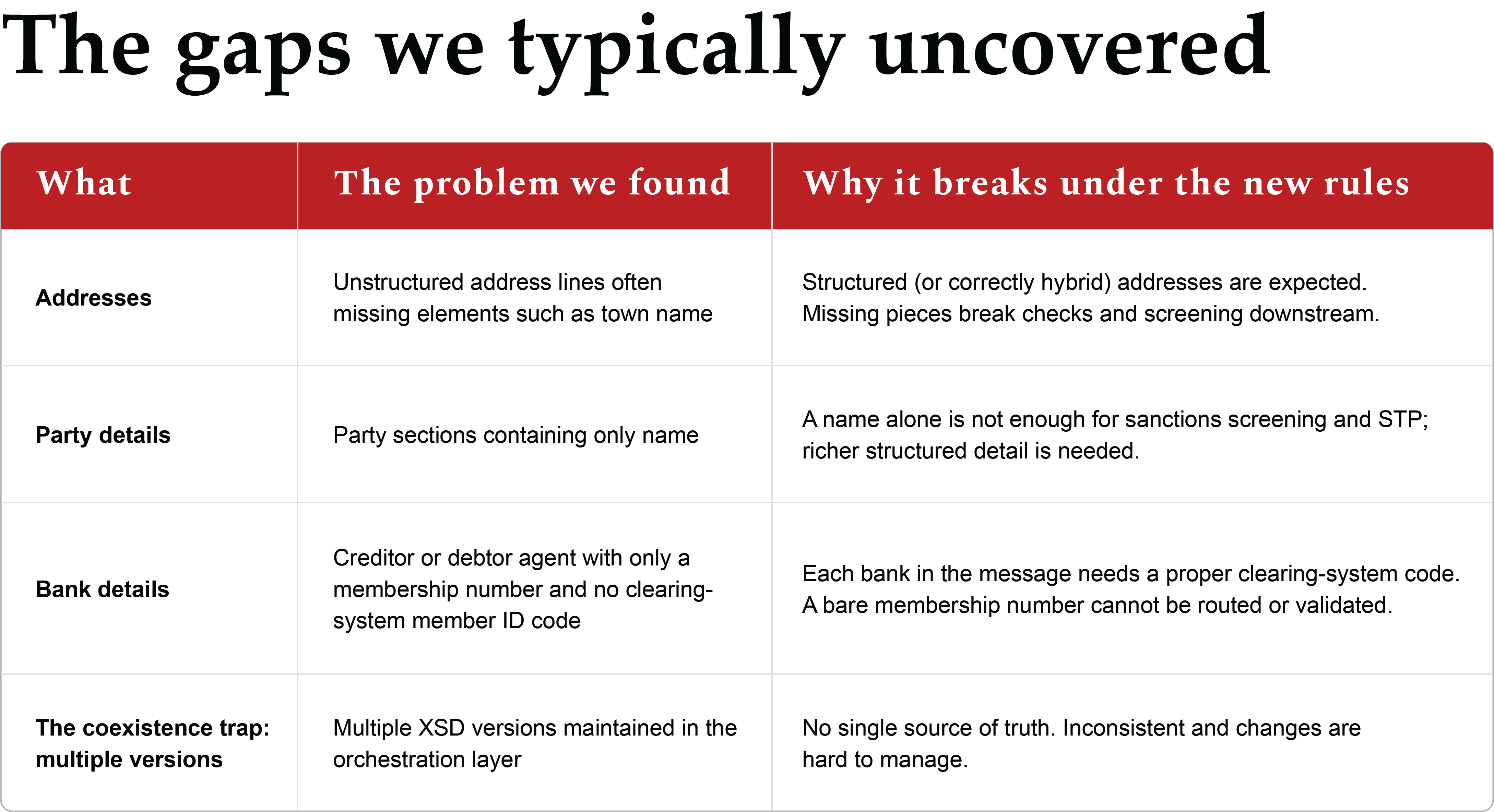
While adhering to address change was a major part of the SR 2026 guidelines, there were underlying data quality challenges. They were rooted in legacy systems and exposed significant gaps in customer master data, ERP systems, and varied source applications.
The current systems did not have the field-by-field complete mapping of payment data, and tracing that uncovered good data being lost at every step.
It could start when a customer typed an address into a free-text box on their phone. The message instructions would pass through channels, middleware, and validation checks with individual limits on field length. Then, they’d arrive at a payment engine designed around the older “MT” format.
From there, the payment data traveled outward. It flowed to sanctions and fraud systems, reconciliation, downstream reporting systems, the ledger, and the data warehouse. Each step was an opportunity for data to go missing.
If a downstream system lacked room for the richer fields, it would trim the new data to fit. There was no error, warning, or failed payment. So the client believed it was screening against complete information.
The issue only surfaced when someone went looking. By then systems had already been working with incomplete data for too long.
And the issue was not limited to retail customers. The same was true when one of their corporates sent a file built in accounting software using 20-year-old formats, crammed into a few lines.
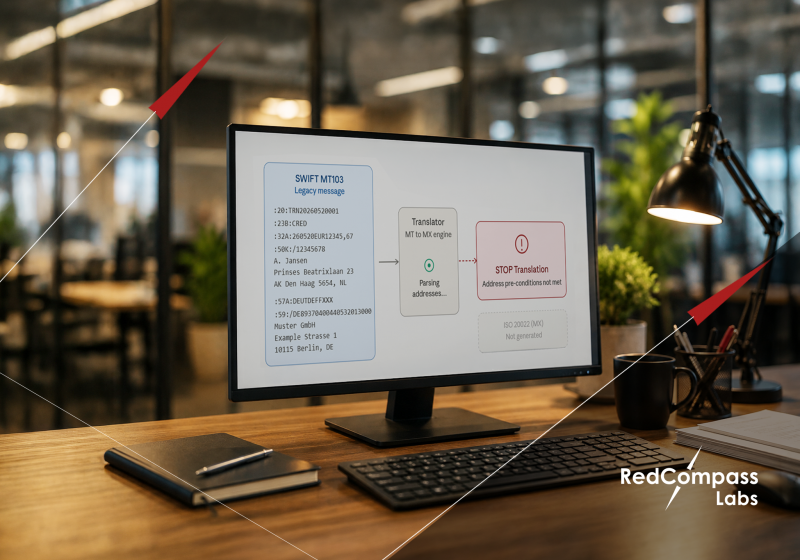
So, to fix this, the FI bridged old and new formats using translation tools. But this was a short-term fix. One that could cause issues post-November 2026. Following SR 2026, fully unstructured addresses are no longer permitted in CBPR+ payments. A translator can’t invent structure that was never captured, so payments might face delays, repairs or rejection at the counterparty or get flagged during screening.
The translation tool may have meant messages travelling to other banks were ISO 20022 compliant, but the client’s own systems still had unstructured data.
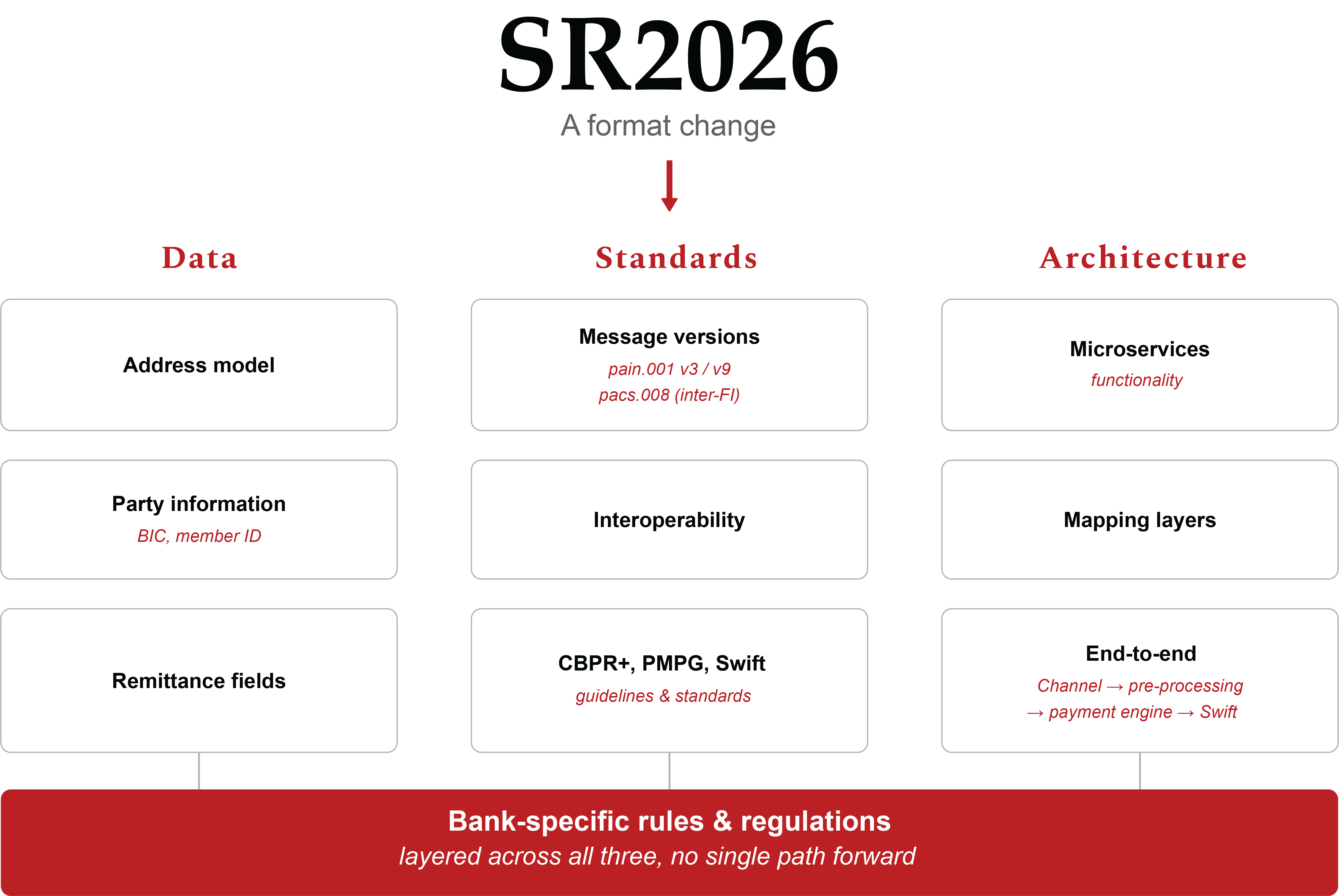
Mapping data lineage reveals where problems live—but it doesn’t solve them. While SR 2026 appears to be a data enrichment exercise on the surface, the reality is broader. Successfully migrating to ISO 20022 requires simultaneous decisions across three interconnected domains:
Data: Address models, party information, and remittance field structure must align to the standard.
Standards: Message versions, interoperability rules, and CBPR+ guidelines reshape what’s permissible upstream and downstream.
Architecture: Microservices, mapping layers, and end-to-end channels (from pre-processing to payment engine to SWIFT) must be redesigned to enforce those standards.
Layer bank-specific rules on top, and there is no single path forward. Each institution’s legacy systems, customer base, and operational constraints force different tradeoffs, creating what amounts to a portfolio of decisions deferred from prior releases, which are now all due at once.
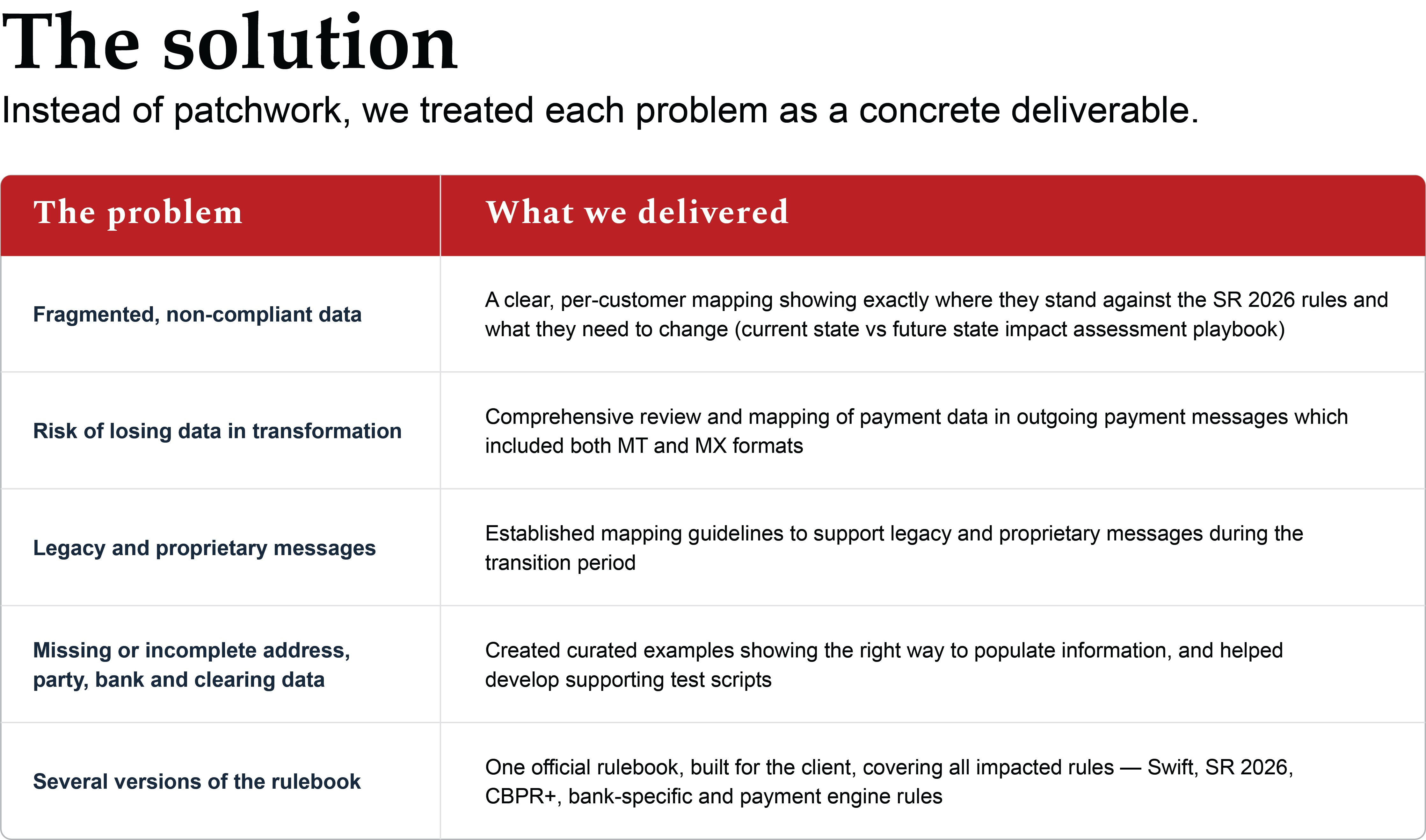
Our work gave a clear, safe path to prepare for the SR 2026 migration with clear data traceability, turning a mandatory upgrade into an opportunity to improve data quality and automation across its payments.
We turned a mandatory upgrade into a chance to improve data quality and automation across its payments. A similar approach will hold true for future implementation.
The result
Rich data is now a permanent and integral part of the payment journey. It’s now captured and kept on every payment and has become an asset owned by the financial institution.
This new system creates multiple benefits:
These benefits grow over time, but maintaining data quality is non-negotiable. Without ongoing data governance, STP rates and rich data quality will be impacted, and you’ll face the same data-quality challenges that predated ISO 20022.
It’s not an option to transition to ISO 20022, but how you make those changes is.
Here are ten ways to approach the migration:
1. Run it as a data project: Ensure there’s a dedicated team for supporting the data enrichments across all layers of payment flow.
2. Map the data: Do this field-by-field, across your payment engine and all connected microservices before writing any code and keep the map up to date afterwards.
3. Standardize inside the bank: Canonical data model stops you repeatedly making the same changes.
4. Treat data clean-up as an ongoing job: tools to parse and score data, people to review the hard cases, and controls that stop bad data getting back in.
5. Treat customer and channel onboarding as a project: The bank cannot send structured data if a customer hasn’t provided it.
6. Factor in client and channel readiness as change management: Phase-out timelines have to be planned around client segments, not just internal milestones.
7. Don’t reinvent the wheel for every customer: Every custom tweak is a small change that you have to maintain, test and support forever.
8. Measure before you go live: If you don’t measure automation rates, false alarms, repair rates, cost per exception first you can’t prove the value later.
9. Hold your vendors to the same yearly schedule: ISO 20022 requires annual maintenance, so your contract should hold vendors to ensuring updates keep pace with the latest messaging versions. Applied AI tools, like our own Payments Expert Agent, can help to manage the cadence and navigate each year’s release changes year-on-year rather than treating each cycle as a fresh project.
10. Plan for a moving target, not a fixed date: Build governance, budgets and vendor contracts on the assumption that the timeline itself may shift again, so the program doesn’t stall every time Swift issues an update.
We’ve helped major banks and financial institutions across the globe with structured address migration. From end-to-end mapping of payment data, to building rulebooks and keeping data quality in place long after go-live. If any of the gaps in this case study sound familiar, you don’t have to solve them from scratch.
Payments Expert Agent, our AI-powered solution for payments modernization, helps teams to navigate ISO 20022 and annual SR-release changes, so each cycle can build on the last.
If you’re evaluating where your own project sits or what Swift’s SR 2026 deferral means for your roadmap, get in touch today.
Share this post

Neha Dasani
Payments Strategy and Delivery Lead, RedCompass Labs

Sumanth Soma
Business Analyst, RedCompass Labs

Darryl Thomas
Lead Senior Business Analyst, RedCompass Labs
We need SLMs steering LLMs to build new payment flows

What vendors, banks and systems integrators must do next

Nobody wants to say it: payments complexity exceeds...

Payments modernization is still manual. AI can change that, but only if we can prove it

Over half of banks have delayed or scaled back a project.

Payments are evolving faster than many banks can respond

We once trusted humans to type payments over telex.










The payments industry is no stranger to transformation, and today...

AI helps banks modernize payments faster.