What should you keep in mind when translating MX-MT messages?
In December 2021, SWIFT announced the availability of its new In-flow Translation service, intending to support banks to be ready for the November 2022 start of the ISO 20022 migration period.
To be fair, ISO 20022 has been knocking around for quite some time, with the first wide-scale adoption of the standard by SEPA (Single Euro Payment Area) in 2008. However, until now it never reached the scale of a global standard shared across high- and low-value payments. Well, this is about to change. Banks across the globe are decommissioning their networks supporting the legacy MT format by November 2025 and transitioning to ISO 20022 en masse, following SWIFT’s decision to implement the standard for cross-border payments and the move of many RTGS (real-time gross settlement) to this standard.
Why is the ISO 20022 migration so complex for banks?
There’s quite a chasm between how the ISO 20022-based MX standard and the legacy MT format convey information. And that’s where all our problems start.
The richness of the two standards is entirely different. MX can carry much more data than MT, with a limited set of fields and an extremely constrained number of characters. While this worked perfectly in the 70s when computers were more constrained, now it is completely obsolete.
MX is not a flat file, which introduces a great deal of complexity for legacy payments systems built for MT messages. With MX, there is a notion of hierarchy between the fields, making processing these files challenging for platforms never designed for this task.
Central banks globally are taking the opportunity of SWIFT’s transition to upgrade their domestic RTGS systems to support ISO 20022, but at differing times and with a multitude of migration approaches, creating a highly complex roadmap for regional and global banks.
Because of all this complexity and the fact that MT is deeply ingrained across banking’s legacy payment systems, many banks plan to continue using their MT-based payment platforms, and, they are opting to go for translation solutions to speak to the outside world, at least until they can justify the considerable cost of migrating to ISO 20022 native solutions.
What are the top challenges for banks choosing the translation approach?
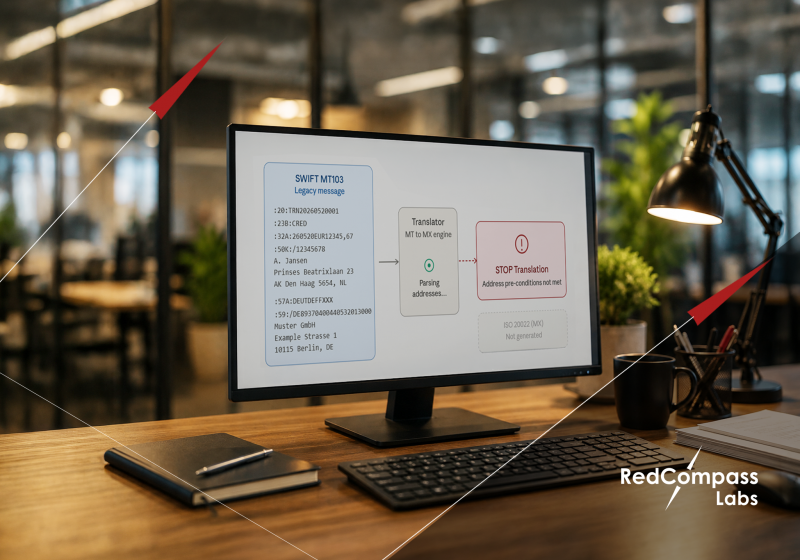
Translating back and forth from MT to MX is similar to switching between a black-and-white and full colour HD experience. It comes with its own set of challenges. The top four are:
- Data truncation. As mentioned before, the MX format offers the option to transmit more information than MT. So, what happens when you send a longer message to a system used to shorter formats? Of course, you lose information and, with this, you run into a very high risk of losing critical data that should be scanned by your financial crime prevention system. SWIFT can actually support you in this process, as their transaction manager will capture all the data received in the ISO 20022 format. However, this service won’t be available until November 2022.
- Double conversation risk. While ISO 20022 is definitely bringing much standardization worldwide, there is still room for creativity and variances for how the standard is used. In fact, we are already seeing different rules emerging between the various market infrastructures, completing the migration process. It means that banks will need to translate from MX to MT using one set of rules and re-convert from MT to MX using a different set. This makes it a complicated process, with an increased risk of losing or misinterpreting data. There’s even a chance of sending a wrongly formatted payment message, particularly when it’s not fully supported by the SWIFT translation libraries in this process, as not all the market infrastructures will be available.
- Missing the required data enrichment. Many market infrastructures are planning to mandate extra information in the future, but it is within their roadmap to start mandating information such as purpose codes or legal entity identifiers. This extra information will need to be collected and captured. As a result, the channels, potentially the payment engine (if it is not already under a native ISO 20022 format), the customer data and the middle layers will need to be updated to cater for the extra information. This can be extremely challenging when the scope of changes demanded by the migration is already significant for such a short time period.
- Non-competitive product offering. As ISO 20022 becomes the new global standard, banks still using MT will miss out. Indeed, the wealth of additional, rich data offered by ISO 20022 cannot be used as a foundation to launch new and innovative services for banks sticking with MT for their internal payment infrastructure. For example, some corporates are looking forward to better liquidity management services, or easier invoice reconciliation made possible through ISO 20022’s richness.
What banks can do to overcome these challenges?
Don’t panic. We know the timings are short, and many banks have to utilize translation services. To make sure that you see the light at the end of the tunnel, here are our top three pieces of advice:
- List all your key payments scenarios and analyze them in detail. With the migration, the devil is in the detail and complicated scenarios like double translation can really jeopardize your readiness for go-live.
- If you plan to use the SWIFT translation libraries, make sure you don’t solely rely on them but are planning to embed them into a broader solution that can deliver the format required by the market infrastructures you operate.
- Think of the next step and have a clear path defined toward a more strategic infrastructure that will allow you to benefit from this migration and the new data format it offers.
Following this advice is not easy, particularly now when there is a global scarcity of real payment experts. As you probably already know, the full ISO 20022 migration has been delayed until November 2025. This means that there will be no more delays..
November is approaching extremely fast. The time to act is now. If you need some support with delivering your ISO 20022 programme, please feel free to reach out to RedCompass Labs. Our team of experts can help you design and deliver a roadmap that will allow you to remain compliant and competitive for the future.