Webinar: Are banks actually ready for digital money?
Not so long ago digital money was written off as a niche experiment, irrelevant to mainstream finance. This is no longer the case.
A 140-strong consortium – including Visa, Mastercard, BlackRock, and Stripe – has launched Open USD, a stablecoin, to take on Tether and Circle.
JPMorgan, Citi, Bank of America, and Wells Fargo are building a bank-led tokenized-deposit network through The Clearing House.
And in Europe, the European Central Bank is moving central bank money onto distributed ledger technology: its wholesale settlement solution, Pontes, launches this quarter, with the retail digital euro heading toward a 2027 pilot.
Three layers of digital money – stablecoins, tokenized deposits, and central bank money – each with live or imminent infrastructure, and each with its own rulebook: GENIUS in the US, MiCA in Europe, the UK’s new systemic stablecoin regime. Every bank now has to work with all three.
Is the industry ready for this change? And how are banks responding?
Watch our digital assets webinar
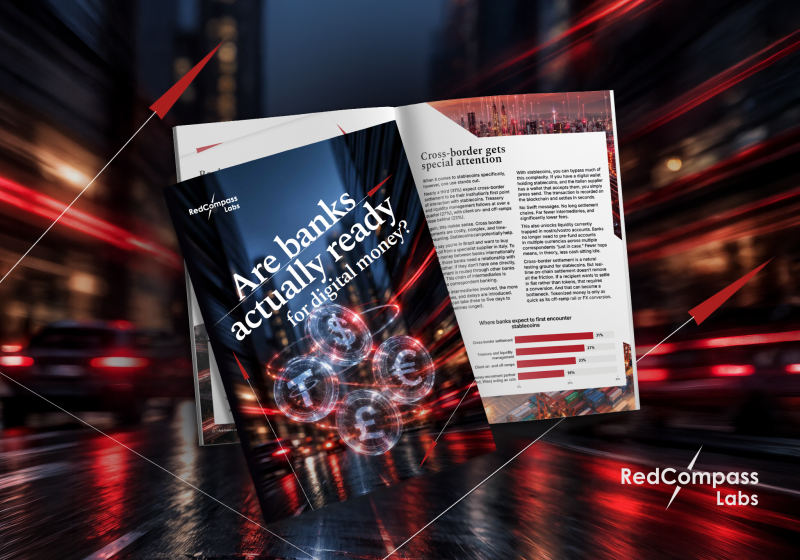
For our latest research report, we surveyed 300 senior payments professionals to understand how banks are preparing for a new era of digital money. This webinar, held in partnership with Finextra, delves into the findings (you can also get your own copy and dig into the data here.)
In this session the panel:
- Breaks down the three types of digital money – stablecoins, tokenized deposits, CBDCs – and which ones banks are betting on
- Explains why 40% of banks are worried about stablecoins pulling deposits from their balance sheets
- Explores how banks can integrate digital rails into their existing payment systems
You can watch the whole webinar in the video above or follow the transcript, which you can find below.
Speakers:
Scott Hamilton: Contributing Editor, Finextra (moderator)
Santhosh Kumar: Senior Payments SME, RedCompass Labs
Mark Willis: Global Head of Emerging Payments, Standard Chartered
Neil Chopra: Head of Financial Markets at Fireblocks
SCOTT HAMILTON: Welcome to today’s the next research webinar. Are banks actually ready for digital money? I’m Scott Hamilton, contributing editor for Phoenix. This is another in our continuing series of events on topics of top interest as we head to Miami for the Global Banking Conference less than two weeks from today. Excited to have such a fantastic panel on board, and we’ll be getting to our conversation shortly.
Glad you could join us and invite you to contribute to the conversation with two poles during the hour ahead to gauge your thoughts and experience. You’re also encouraged to ask questions during the session, and we’ll try to answer as many of them as we can. Most importantly, you’re strongly encouraged to download the Info Pack report available from our sponsor, Red compass. It contains clear and helpful definitions, provides an up to the minute review of digital money and its present and evolving status in the marketplace, and it shares comprehensive current results on digital money, attitudes, behaviors, and expectations. From a survey of 300 senior payments professionals from key markets in North America and Europe. This report might be the most accurate, hard hitting and helpful guide available anywhere on the topic right now.
Our conversation today will explore some of the challenges and solutions digital money, products and services bring to financial institutions and their customers. Our panelists will be tackling some tough questions and exploring compelling use cases already in place, as well as a few on the frontiers of future implementation. Some of these questions, whether obvious or perhaps hidden a bit under the surface address, why and how banks of all sizes actually are now joining digital asset consortiums. Why traditional infrastructure providers like Swift and the clearinghouse are devising sophisticated guidelines and platforms to smooth the rollout of these digital assets frameworks, and why and how some banks are leading the way to introduce and successfully incorporate digital assets to complement their broader offerings in the market.
Some are ins next week, and with the U.S. Congress seeking clarity, it doesn’t take a genius to know there’s confusion in the market right now. Consternation, in fact, by many bankers and choosing the best course to take when adding digital money products and partnerships to their present mix of payment and liquidity solutions. Addressing concerns about deposits being siphoned off by competitors, maybe upstarts, or considering how to compete effectively and cost consciously in a marketplace. This moving to full 24/7/365 day mode. It’s all challenging the capabilities of their core and payment systems already creaking under building pressures. To add ISO 2022 AI augmentation or reimagine workflows to their present frameworks. Wondering how to accomplish these objectives? They’re wondering how to protect their bank and their customers against increasingly creative and technologically sophisticated financial criminals. And all of this while operating in line with those constantly changing cross-border regulatory regimes and in country and regional digital asset compliance requirements. Not hard at all.
But if you seek sensible and actionable solutions to these questions and quandaries, you need guidance on how to fine tune your plans to adopt and successfully deploy digital assets within your bank. You’re in the right place right now. I’m pleased to welcome our market tested panel of experts. Santos Kumar, Senior Payments, SM for Red Compass Labs. Mark Willis, global head, emerging Payments for Standard Chartered, and Neil Chopra, head of financial markets for Fire Blocks. Santos. Let’s get the conversation started by breaking down this vast digital topic, our digital money topic and adjustable bites. Talk about the state of the marketplace right now. Describe what your company’s research is telling us about how stablecoins, tokenized deposits, and CBDCs are or will be fitting into the global banking picture, and what should banks be ready to do about it? Santosh.
SANTOSH KUMAR: Well thank you Scott. I think it’s a great context, great introduction and a great topic. Digital assets. Right. And I would just would like to start this way. You know, I’ve spent years in payments watching, you know, rail after rail that is getting built and honesty. Sometimes I miss those old days when money is just meant to be in your pocket, and nobody asks you to explain it. Right. But I think those days are gone because now there are four different kinds of beast, different kinds of digital money where I could see this. Most of the industry lumps them together as a one thing. That’s exactly where the confusion starts. So let me just go and make it simple to define these these fast technologies. Right.
So the one cleanest way that I found to tell them apart is one question who’s actually owes you the money? So I’ll take a $10 note. Explain each of these layers. So imagine a $10 physical note is basically claim or promise on your central bank and CBDC central bank digital currency. Is that the same time, same promise that’s in a digital form is basically your digital climb on your central bank. Imagine the one that is working the digital euro. That’s the example of it. The second one is same thing. Dollar on your bank account is liability and promise on your commercial bank. That’s the tokenized deposit. Same balance, but it is programable. Now. So when I say programable. Same money, same protection, put it on a shared ledger so that it can move instantly. But the important thing about the tokenized deposit is that your money never leaves your banking system.
The third way it is your deposit token is an interesting cousin because people often get confused between deposit and deposit token. It’s still your bank money, but it’s built to travel between the banks. So it’s banks to banks. Valid to valid. Not going to sit within your own bank. So imagine it has got a passport now so that it can travel across the banks. That’s the difference. The fourth layer stablecoins. We all know that. We all know the definition. So same $10 stablecoins is climb on who are issued it and whatever it is backed by. When I say hover issued could be private equity bank or it is a bank that is now moving. And then, you know, start issuing the stablecoins. So it always back back one is to one by the reserves. Imagine this as a prepaid card. So long story short same $10 money but different institution behind it. And it’s a different promise. Just hold on to that.
So whenever someone talks about digital money, the one question that comes through is who’s promises this and what’s behind it and who is holding that? This is the question that first come through in your mind. And then the second question why now? So I would like to frame this way almost all the money already digital today. But what is missing is it is not so native to the digital economy. Think of like this. You’re messaging your Netflix streaming. You’re shopping. Everything is real time programable around the clock and can move globally instantly except the money. So what we have done is we have actually digitized the access to the money without ever built a form of money that is designed for the internet. That is the gap. That is that is the gap. Everyone is trying to fill your tokenize deposit, your digital money, everything is trying to fill into that. So just 18 months before or within the 18 months, we could see that how the conversation is moving to a bill discussion now because your bank started putting into your money, funding, staffing, putting to the roadmap. So that’s a clear direction.
So who are banks sitting in this call? The one question they should think about it. You’re not going to pick any one of these layers because your customer is going to touch across all of them. So back to your question, Scott. Is the industry actually ready? So we didn’t guess. We went to a market. We asked three. And the senior professionals in the bank are on six market especially understand this one question which layers the banks are betting on. And you know, surprisingly what the data shows around 7 in 10 banks are hedging across all these layers. Either they’re piloting building planning each of these layers. So that’s a I mean no single winner. That’s a dead genuine heat, right. And out of that, on the other hand, 1 in 10 lives in production today. So the whole industry is moving, but nobody has arrived yet on other side. The hedging has a hidden cost. The hidden cost is sorry, the hidden cause, it’s own real story. Because you are spreading your investment across three different paths, but you’re not winning any one of them. I think that is the strategic, not where banks are listening. And this is where exactly we are going to unpack today. Thank you.
SCOTT HAMILTON: Excellent, great, great overview. And a lot of this is in the report. There’s more statistics. We’re going to be talking about some of them. But excellent start for our conversation. Mark Willis thoughts from your perspective. You know being out there in the banking world calling on clients. What what do you think about Santos’s opening comments? Let’s talk talk more about what’s out there right now in the marketplace. The challenge is the use cases that are proving this. And how is how are digital assets solving problems for your bank and its customers? And you’ve explained to me, as we’ve prepared for this session, that, you know, they’re disruptive for sure, but their deployment definitely varies by specific locales and reasons. Maybe they’re starting to be mixed with other traditional payment methods. Let’s hear your thoughts, Mark Willis.
MARK WILLIS: Yeah. Thanks, Scott, and good to be here today. And, thanks for the intro, Santosh, and the explanation of the different layers of money. I think I think, though, when you look at it from a banking perspective, it is important to understand that, you know, whilst we see these as digital representations of cash, and how we move money, they treated very differently. For example, when we look at a tokenized deposit, from a banking perspective, it is easier for banks to deal with from a product lens because that’s just a normal liability or a deposit product for us. So although stablecoin mimics, cash in the sense of how it can be moved between counterparties and participants. From a banking perspective, we will treat that as an asset, because the look through to the reserve is, you know, a book of assets. Right? So these are, you know, some of the nuances which become important for the banks and how they approach these products.
Yeah. And I picked up on another point, which is really what you said around, you know, the internet for money, right? And the speed of the internet and the speed of money. And I think, you know, whilst it’s easy to get caught in the technology layer and what the technology gives us and all the valuable properties that blockchain and smart contracts and tokenization gives us, but the fundamentals of of banking around trust, relationships, liquidity still remain. Right. And I think if you look at a lot of the interoperability solutions that are out there, it’s really about solving for, you know, bilateral relationships and trust, which exists in the corresponding banking, network in business today, versus building a multilateral system which always needs a trust anchor, which in many cases domestically is the central bank, right. So I think, you know, I think we all agree in the industry that blockchain as a, as a technology, tokenization is a technology is the future market infrastructure, technology. But there are these fundamental layers that need solving and is not necessarily a technology problem.
So, you know, coming back to your second question, Scott, around, you know, what do we see today and specifically around the report? And, you know, where banks are betting. And quite interesting that we see seven out of ten banks say pretty much which is our thesis. Right? They they are not competing in the sense of what we would be building tokenized deposits for versus how we would or see stablecoins being used for our clients. I’ll give you an example. Right. So we’re starting to see that demand, you know, from, let’s say, for example, corporate clients that are saying, hey, I would like to be able to pay this supplier in stablecoins because I’m getting invoiced in stablecoin. I don’t I don’t want to have to deal with a digital asset native. I don’t want to open up wallet infrastructure. I don’t want to deal with that Web3 layer. I just want you to treat this like another currency. You could say. Right. So just integrate that, you know, into my existing banking relationship, take the fiat from me and pay out in stablecoin. And the reverse exists of course, because we’ve seen the the use of these stablecoins, particularly in the emerging markets corridors, right, where access to dollars is limited. This is really where if you look at the data, the growth in the B2B payment side of stablecoins has been markets like Africa, Latam and other emerging markets. So, you know, how do we help our clients get that reach and treat it more like a currency, both from a pay inside and a pay outside. So we see it much more as a reach, in the payment space and treating it like another currency and how we can support our clients in that case.
On the flip side, you know, we still see that Treasury sort of wholesale liquidity being more of a tokenized deposit solution. We’re seeing the market evolve, you know, in terms of what the interoperability layer looks like, whether that’s domestically in certain jurisdictions. You’re starting to see, let’s say, clearing schemes for tokenized deposits. And then of course, you know, as, as Santosh said, that that holy grail of solving for cross-border or, you know, multilateral trust systems that that can bridge jurisdictions. You’re seeing, you know, a couple of those starting to come to the fore, but still a way to go for the industry there, I would say.
SCOTT HAMILTON: Thanks, Mark. Really appreciate that perspective from the field. And we’ve had some audience questions about how this works and what does it really cost. And we’re going to be getting into that as we go compliance as well. Neil Chopra, what might you add to what Mark and Santosh have shared our digital assets and currencies, really, you know, from your field taking the world by storm or they’re still some pretty significant issues and obstacles out there to their efficient deployment. How do you view these new digital asset initiatives that are coming out from Swift in the clearinghouse? And I’d love to hear your observations on how things are now and what they might look look like in the future and the the future state of sable coins and other digital assets in the market.
NEIL CHOPRA: Yeah. Appreciate the appreciate that. I think you guys sort of hit the nail on the head with with all the comment commentary there. The one thing I think that’s really interesting observing, I’ve been at five blocks for about five and a half years now, is at ripple for just under four prior to this. And so have been engaging with banks in sort of digital assets and liquidity management for for almost ten years now. I think to the point of the genius act clarity. We’ll see what happens later today on that vote. But ultimately, we’ve already seen posture from regulatory bodies in the US to say there will be guidance and guardrails for banks and regulated institutions to participate.
I think the interesting thing that we’ve seen over the last year or so is the rest of the market is not necessarily waiting for banks to provide these services. I think what you see with Moneygram and Western Union as an example is the ability and now the opportunity for more traditional institutions to actually take more control and ownership of their liquidity processes globally. And so what we’re seeing there is actually leveraging stablecoins to be used as a form of funding for liquidity partners in various jurisdictions. I think the friction point that we have now with stablecoins is the fact that we don’t really have depth of liquidity in off ramping and on ramping into currencies outside of the dollar.
And I think that’s the really interesting thing that we’re now starting to see. So, earlier this year, which is a consortium of now upwards of 30 banks in Europe have issued Cue Euro, which is now a regulated stablecoin under MCA. We have cab D in Canada. We have obviously, the US dollar backed stablecoins and a number of others globally. And so I think what we’re starting to see is a little bit of a bifurcation of the market, where banks are stepping in and saying, we need to understand how this technology plugs into our existing infrastructure, technology and processes. That first step has traditionally been through the lens of tokenized deposits. And so, referencing the clearinghouse Swift, I know the BIS is doing some work with Project Agora as well. There’s a lot of now applications and utility for banks to actually participate in tokenized deposit consortiums, but we’re also now seeing an acceleration in the adoption and usage of stablecoins more directly by non banks. And I think that’s the really interesting piece that’s going to start to or continue to push banks to, to need to engage with this technology and with this market because I fully agree it’s it’s kind of here to stay.
No matter what we’ve proven the utility cat’s out of the bag. The technology works. The technology is scaled. We’ve proven that in the crypto world. Now it’s trying to understand how do we fit this infrastructure into traditional market structure. It’s happening with payments, with the DTC initiative. It’s starting to happen with treasuries as well as money funds and equities. And so we’re just going to continue to prove the utility of the technology across all of these different asset classes.
The interesting element that we’re starting to see evolve on the stablecoin side now is non dollar stablecoins and the ability to potentially access on chain FX. And I think the really intriguing part about that is you now remove the requirement of bilateral relationships for off ramping of stablecoins into fiat. If you have two different currency stablecoins and market makers willing and able to provide liquidity into those currency pairs. So now what you have the ability to do is actually tie the liquidity, sourcing, the execution and settlement all together into a couple of steps in a couple of minutes versus the traditional funding model. And so I think as we start to prove that model out, it will still it will continue to drive. I think the rest of the market, because again, we have to prove it at a small scale first. Once that’s proven, it will get adopted and ultimately start to scale. Moneygram, Western Union and others are doing this now at scale because their entire business is built around efficient liquidity management. They see that value and that is why they’re going full scale into this.
I think as they start to prove that other payments companies will step in, then it’s a question. And I saw a question in the Q&A. So apologies for front running that. But excuse me. So when you have programable money that can now be tied into supply chain management and trade finance, that’s where things get really exciting. But banks need to start with the foundational layer of the technology. Understand again where and how this plugs in, how this changes operations, processes and everything that they do on the back end. Once that is in place, then we can start to build out these other applications that drive efficiencies up and down the value chain.
SCOTT HAMILTON: Awesome. So now we’ve got definitions. We’ve got what’s really going on in the the banking marketplace, banks and customers. We’ve got sort of a forward look not only on the current but also looking forward how all of this is going to wash out, how it all fits in. Got our first poll for you audience. This is your chance to weigh in. And it really comes down to which layer are you focused on right now in your institution? Are you looking at third party stablecoins? Are you joining or thinking of joining a consortium for tokenized deposits? Are you looking at these wholesale CBDC sees as an area to work? Or, you know, all the ones that were just mentioned? We didn’t I don’t think we mentioned the digital euro. Or are you doing nothing at all? Is that really simply not. You’re not focusing on any of these layers right now while you answer those questions.
Santosh, first a couple, any follow ups to what you just heard? You I know you’re going to address the that one of the questions from the audience on rising costs. But also with all these evolving use cases in each layer, there’s also some concerns. We’ve talked about it at the beginning. I mentioned it, some of the worries that you’ve been hearing in your conversations. And as customers demand more or some major players in fintechs, as we just heard from Neil, are, you know, kind of pushing it, what kinds of competitive or compliance concerns are also coming up from payment and depository providers?
SANTOSH KUMAR: Great question. Absolutely. So on the use case itself. Can you hear me? Yeah, we got you. Can you hear me? Okay. Yes. Perfect. So, sure. Honestly, the use case for not the surprise. Because what we are seeing on the stablecoins, the data points exactly where you would expect, you know, cross-border liquidity, capital market settlement. These are the top, top three use cases where we’ve seen our survey as well as in the industry. So that’s matching. That’s the that’s the pattern I keep coming to. Money follows the friction and friction right now in the cross-border. That completely makes sense. You know, but that’s the appetite, right? That that makes sense.
But the interesting thing, the real story is in the concerns underneath the appetite. So the two top two concerns, what I say is the first worry in the industry is that deposit flight. So because it’s where the digital money stopped being a payment story and become a balance sheet story, right. Because we all know deposits are cheap, it’s a sticky field that bank lent against it. But imagine the moment that the balance go away from your account to the stablecoin account to that stablecoin issuer, that’s not a technology problem. That’s the funding problem, because that’s going to hit the center of your banks. That making money today. So what our survey shows is 40 percentage of those senior banks expect to lose the deposit to the non-bank third party money and 29% age they feel that they will get they’ll get the gain back.
So the the mode is clearly nervous. But here’s the real story of that 40% age one five percentage have modeled it, sized it into their liquidity planning, another 35 percentage. They are coding that it’s there in the Red heart, but it’s not a quantified. So here’s the uncomfortable bit. Almost everyone is worried but almost nobody has done the max it. But it’s natural place to be this early because I’m not throwing stones. It’s cheaper right now to figure out on your own terms to put the proper number on your model. It’s going to be expensive later to figure out when the market pushes.
So that’s the first and second worry. I would argue it’s one that actually, you know, decide who wins. That’s the governance problem. So in our survey no single function even owns the digital asset such into today your innovation your payments, your treasury your C office each owns about the fifth of it. And you know how this goes when four people own a thing nobody really does. So before this is a technology problem, it’s the governance problem that’s the biggest worry. So the banks that move first will not be the one with the cleverest technology. There will be the ones where somebody is actually holding the pen to make the score. So these are the top two worries, concerns on the use cases. Thank you.
SCOTT HAMILTON: Thank you for that. And I just keep coming back to what Marc said about trust being kind of the foundation of all of this big part of trust is knowing what you’re doing and how it’s impacting your bank and also your own compliance. Neil, any surprises for you in the poll results?
NEIL CHOPRA: Oh, we got to bring up the poll results I apologize, I thought we had a second. We want you to read the mind of the people know. But first of all, it looks like we do have people focusing on being a consortium and dealing with stablecoins. So no big surprise or the biggest news in the marketplace just about every day you talked about some of this. Any thoughts first on those results and then anything to add and what kinds of other digital asset alternatives are using and non USD forms? I’m kind of curious because USA owned 95 to 99% of the whole stablecoin market, for example, and we all think that that’s not going to last forever. New applications or use cases that have become more prevalent as those CBDC central bank digital currencies evolve.
Yeah, I’ll say the poll results. Not surprising really at all. I think if you look at the landscape of of banking, 100% of banks are deposit taking. Institutions do lending and payments full stop. You then have other business lines that are built on top of that. But specifically in the US we have upwards of, I think, 4500 banks and credit unions. Not all of them are. The majority of them do not do anything in the capital markets world, but they all take deposits and they all do payments. So the application of this technology within those business lines is very, very clear cut, I believe. And so I think for that reason, you’re starting to see that as the initial insertion point for a lot of, of banks, at least in, in the US.
But we’re starting to now see that trend more globally as well. And I think that is because we’re starting to get clarity around regulations in other jurisdictions as well. So I had referenced Pew, Euro and the consortium, we have regulated stablecoins in Canada, Hong Kong, Australia, Brazil, etc.. And so I think because of that, we’re going to start to see, I would say, more traction from banks in a lot of those jurisdictions because the regulatory framework is at least starting to be put in place. And I think this is the critical piece is banks need to, I believe, start building ahead of regulations and be more proactive.
Santos, you your your comment there was was spot on. We we work with a lot of banks globally. And the decision making for these types of initiatives is is really dispersed I would say across multiple teams. We now obviously have this. We can’t have any webinar with without referencing AI anymore, but we have a lot of money and a lot of time being spent on on the AI space. We did this in blockchain. We did this in crypto three, 4 or 5 years ago. Already. We’ve proven the model, we’ve proven the utility. Now we have to figure out how to adopt it. Any technology owner, any security owner at a bank who has AI as a priority for their institution, full stop needs to have blockchain as that as well, because AI does not scale anything transactional that comes out of that. Technology will require wallets and blockchain. Santos to your point, to move value at the same speed that data moves.
And so this is now a question of when is the right starting point for banks. And I think that is now if it wasn’t earlier this year, because if you start to hear demand from clients towards the end of this year, you’re still six, eight, 12 months away from launching something in production. And we can only assume that that demand is going to continue to accelerate. And you can only assume that corporates, small businesses and consumers are going to look for better, faster, cheaper services elsewhere. We’ve seen this over the past 20 years with the move to digital, and all we really did was slap the digital interface on on top of bad infrastructure. Now we’re changing up and we have the opportunity to swap out that infrastructure.
The fintechs will move and are moving faster and they are enabling this. And the friction point right now is banks are going to be our banks are slow to react and they are very reactive. The ones that are proactive have been in this space for years and have already built out that infrastructure. So we now have, I’ll say this second movers and the third movers, or the fast followers who are stepping in to start to build today and the rest of the market will ultimately have to follow. It’s been a question of what’s the share of wallet reallocation over the next couple of years, as new novel products and services are start to get start to get built on chain. It’ll start with payments, it’ll start with cross-border, because that’s where the friction point is. Stablecoins and fiat are less regulated than securities. So we will see faster adoption in that space.
But then we have, as I mentioned earlier, a number of other assets that are coming on chain and proving that utility, the ability to use treasuries and tokenized funds as a form of collateral is just another step function in this technology. So you have this technology wallet layer, which is where Fire blocks plays, provides that infrastructure to regulated financial institutions. We now have a settlement layer that’s evolving with stablecoins. Tokenized deposits and deposit tokens will then have a liquidity layer that’s built on top of that, which is tokenized money funds and tokenized treasuries. And then from there, it’s really a question of how quickly the market adopts other asset classes to build on top.
But until you have the ability to be able to move these assets, hold these assets and ultimately convert in and out of them back into dollars in a bank account or the equivalent, hopefully a tokenized deposit or a stablecoin. Until we have those layers established, it’s really going to be really difficult for for the rest of the assets to come on chain. But again, I think we’re starting to see that inflection point, and we’re starting to see the acceleration of stablecoin utility. And I think that’s the really exciting part that that that we’re seeing in the market right now.
SCOTT HAMILTON: Appreciated I think I think you you hit the nail on the head that you’ve got use cases multiplying. You have customer demands rising. But there’s still that trust element. We’re going to come to Mark because you know he’s out there working in the field talking with clients about all of this. Not not only your thoughts on the poll answers, if you have any. I know we just dropped them down, but basically, you know what they were stablecoins were very important. What are customers finding, you know, is makes the most sense for them because that’s another thing about this stress. It’s I just want to run my business. What makes the most sense for me? How can you put it all together, how to make it all part of your your bank’s mix of various rails and make it more interoperable, easier to understand, easy to implement and maintain? And then just any thoughts you have on compliance. We’ve talked about it a little bit. You have a very diverse marketplace of customers. A lot of questions for you, Mark, but just sort of your view on where we’re really going on a sensible basis in the field.
MARK WILLIS: Yeah. Well, let me let me start off by saying, again, at the level in the poll, I’m not surprised because I think, as I said in the first round, they serve different purposes. Right. And I’ve seen a couple of the audience questions and I’ll and I’ll get to some of those answers with examples. Right. But you know, if you look at let’s talk about stablecoins for a second. Right. And some of the things Neil was talking about, I mean, the market cap of US dollar stablecoins is around the $300 billion mark today, right? All available liquidity is sitting at that, that level. Right. The US repo market is, you know, close to $3 trillion daily. And if you look at the activity that’s happening in there, the banks that are trading with each other, there managing their balance sheets, right. And they and they and they taking in cash and they’re borrowing securities or they’re doing swaps on currencies, etc.. It, it it for one problem, of course, is the size of the liquidity of, of stablecoins. Number one, two is the bank needs to recognize that as cash on the balance sheet or a liability, you know, to manage the overall balance sheet. Right. So the instrument is not correct because as I said, firstly, the bank can’t hold it and represented as a deposit number one, the same will go for customers. Right.
So and I think Neil touched on this briefly, which is really I’m not going to sit on a whole lot of stablecoin liquidity. If it’s non-interest bearing, I’m going to flip it into an enhanced yield product, be that it, you know, tokenized deposit or a tokenized money market fund or, or any other tokenized RWA that’s going to provide me with, with yield. You know, so there are these two ends, right? And I see stablecoin being much more of that utility that reach and that access, you know, that quick movement of funds, but it’s going to get converted on either end. There’s something more, more meaningful.
We also spoke a little bit about, you know, the fundamentals, which is really access to that liquidity is still an issue when you want to convert it into a local currency and an emerging market, you know, on both ends. Right? So these fundamentals still exist, right. And we need market participants to come in and and, you know, create that market depth and make a market so that, you know the ecosystem can grow. So we sort of sitting in you know, that stage, I guess, of evolution in the industry where it’s just starting to happen at those points. But there’s a long way to go.
So, yeah, I mean, we see definitely a difference in terms of a how we position the solution, and b what we hear from clients and what clients need them for. Right. I saw one of the questions in the, in the Q&A around, you know, you you said 24 by seven for tokenized deposit and you can do that with fiat. That person is 100% correct. I think as an industry, we’ve marketed tokenized deposit as, as this 24 by seven solution. But the reality is you can do that with a database and normal systems today, right? Because you’re just doing book transfers within a particular bank’s perimeter. Right. I think what’s happened is, you know, and Neal said this, you know, because a lot of these bank systems are have been there for multiple years and they’ve been layered on and they’ve had ISO changes and, you know, years and years of change. It’s difficult to keep them up to date in terms of the speed and pace of change and provide the properties of 24 by seven. It’s not to say that you need tokenized deposit to do that. Right. So so why do you really need the product is around. It is the right to play in the tokenized world, right? So the minute there is an interoperability network, the minute there is a use case where I natively want to purchase or sell an asset with a tokenized deposit, I want to, you know, exchange a tokenized deposit with another bank through some sort of clearing scheme. You need it there. Then we talk about, you know, programmability, whether that’s a PvP use case, as I mentioned, or a DVP case or, you know, liquidity rules within the the tokenized deposit, that’s when it gets interesting. But I think we just all quite new, let’s say in the evolutionary stage of tokenized deposits. And obviously step one is, you know, get it out there, get it out there as a value transfer mechanism, provide that infrastructure, prove the technology, start treating the blockchain as a sub ledger as your books and record, you know. So get all those foundational pieces and then, you know you unlock the next sort of level.
SCOTT HAMILTON: Just just an outstanding way of describing, you know, some of the issues and challenges. All of you have done a great job. And I think if I was running a corporate treasury, I’d think, okay, so the bank’s telling me the table stakes is that they’re going to be able to play the game, but how much are we going to bet on it? How much is the bank really betting on it? What consortiums are they part of? You know, also where do we operate around the world? We still haven’t talked too much about the difference in compliance. We are going to start off with our second poll. We’re going to talk about one of those risks. And we want you to weigh the size of that deposit by risk in your mind to your bank. Have you modeled it? Have you planned it already or not really. Roughly. We’ve talked about it, put a number on it. Started to or no, not yet. We haven’t looked at this in any real depth. I think that’s a great question for you in the audience answer, we one thing I’ll mention we have we do have stats also very, very interesting stats that Santosh has spoken about in the report that Red compass generated is super helpful. I read it the other day.
Santos, what might a growing role for digital assets really mean to banks? You know, Mark just talked about what it means to them, how they’re responding. He’s spoken some depth about what it could really mean to them. We you know we the cost to them. But what it means to them, their customers and what questions are rising when it comes to not just losing this deposit revenue, but also meeting client needs that are that are rising and then that interoperability we talked about, you know, how it’s all going to work with foreign exchange again on ramps and off ramps still exist. They’re going to exist. How do they make it all worth their bottom lines and also stay competitive. And then please, you know, how are banks addressing compliance concerns when they work in multiple geographies? A lot of questions. But we’ll keep going.
SANTOSH KUMAR: Yeah a lot of questions. So I just want to make one point on the first poll. The the the pattern was renting to learn versus building to keep. So when I say renting to learn, that’s where they’re connecting to a third party stablecoins building to keep is where they are building their consortium, tokenize, deposit, etc.. So we have clearly seen that they’ve started with tokenized deposit. They were building the expansive islands walled garden. Now they are moving towards the consortium. So I think that’s a that’s the answer clearly shows that that’s what it’s not surprising us.
So back to your question on the on this one. So first one is this is the heart of it for me, because the honest answer is the winners on these layers will not going to replace the old rails. They’re going to connect them because your asses your guess your Sepa are not going anywhere. The amount of work we have done on the fed now on the Sepa instant, those innovations or the real innovation there. So this is not about the replacement. It’s like another rail joining the mix and but the value is in the orchestration. Someone talks about what will happen to the core banking ledger. What will happen to the payment hub. I think your payment hub is going to do the orchestration layer that routes the each payment to the right one.
And second point on the interoperability you touch that always in payments in probably it is a hard part which over payment type you take. So because different jurisdictions, different countries playing together different cut of time zone etc. and also biggest worry in our data is nearly either that digital asset networks is not talking each other’s will not talk each other, or they just get logged into the one providers garden. So it means everyone is building, but almost no one is connecting. So today, once banks token works beautifully inside the bank JP Morgan city, we have seen that. But that’s not the network. You know that’s a I would I would call this that’s a collection of very capable expansive islands. So the next wave of the value is not building another shiny token. It’s it’s the bridges between them. That’s how you saw the probability.
But we are not speculating about this bridges anymore because we have seen the Swift, which is on 19th August, Standard Chartered. And they have done the first pilot cross-border tokenized transaction over Swift’s new ledger. And how it works is the whole story of this panel, because each bank kept their own token system and Swift’s ledger sat in the middle. And basically it is matching and netting the obligation. But then the final settlement that run through your existing traditional rates. So what does it mean that new technology did not replace your old plumbing? It sat on top of and made two walled gardens to talk to each other. I think that’s the complement, not replace. Right. So that’s the interoperability thing that banks are started solving. Swiftest on top clearinghouses joining. So these are some of the players infrastructure players is going to solve that problem.
And the last question on the compliance the data says that 89% of people are very confident about understanding the regulation rules. But on the other hand 112 percentage say they are valid level sanction or AML controls are fully ready. A bit contradiction, right? It’s not. It’s like you knowing the speed limit is not same as having your working bricks. Imagine sanction screening one piece we are still solving in the instant payments layer. And now you’re going to sanction on the valid transaction, which is you’re going to see for the first time and on chain on scale. Imagine. So I think that’s the real gap because some of them say mostly ready. Mostly it is still a partial test. Right. So that’s the gap is the whole program. So the readiness gap that decides who actually move considering your core banking, your liquidity, your sanction, your own Dram off ramp, etc.. And this is how I want to close.
Someone asked about the cost analysis. So that’s going to be infrastructure cost, because 56 percentage of people expect that they’re going to work on their existing infrastructure. And the gas phase, I think once it becomes a enter into the permission layer, like Swift ledger and the clearing house, they are not be any gas fees, etc. like just you work on top of the Swift ledger. Yeah. This is what my argument about.
SCOTT HAMILTON: Thank you. Thanks. And it’s going to be an individual question. This is not going to be cookie cutter. Every bank has different operating markets has different customer base. But Neil we’re going to go ahead and post the results. Get a chance to comment on them. And then same question to you. Any other factors we haven’t talked about that come into play. Oh boy a big no not yet. We’ll have to. A lot of people have asked about the link to the report. It’s available on your resources tab. If for any reason you can’t get it, please let us know. The report that we’ve been talking about is there. This is our own report. Some people have discussed it, but two thirds have not. Your thoughts on that and any compliance and governance questions you’ve kind of fielded. And back to that cost question. What do they need? What’s it going to cost? How do they justify the expense? If you’re if they’re a bank.
NEIL CHOPRA: Yeah. I will say I mean, on the, on the cost side to start to, to implement and integrate this technology honestly is not a material cost to the bank. To start. And I kind of look at this. I spent my career before enterprise blockchain in the corporate treasury world. Sexy, exciting world of global liquidity management and payments and hedging. I truly see this as as a hedge that banks really need to step in and figure out, because it is a fundamental risk to the business. I think that’s where with the back and forth we saw with genius and with clarity, it’s the banks kind of saying we are not ready for this, and this is a risk to our deposit business, and rightfully so. I think it’s then a question of how quickly does this ultimately get adopted.
So if I take a step back here as well, we look at the risk to the business for banks. If I’m a fortune 50 company and I own my supply chain, the technology is there and technically the regulations don’t disallow the ability for them to issue their own stablecoin. So if I’m a Coca-Cola, if I’m a Walmart that owns a global supply chain, nothing really stopping me from going to buy a bunch of treasuries, issuing a stablecoin, and using that up and down my supply chain and taking all the float away from banks. If I was still in my consulting role on on the Treasury side, I would be shouting that from the rooftops and going into every CFO of every fortune 100 company and saying, you have the ability to do this today. And I think that’s the piece that a lot of banks are not necessarily wrapping their arms around right now.
I think everyone’s kind of waiting for the pieces to get put in place. I think if we wait til the pieces get put in place, it’s too late. Which is why we need to start building now, because again, the technology is here. The technology is proven from a security and scalability perspective. It’s now who’s going to take it on and adopt it and drive the scaling of it. And I think there’s a lot of bank customers who have a lot of opportunity to take back float that they have otherwise really conceded and given up the banks. And so it’s a question of how risk on some of these fortune 100 companies are, especially on the tech side, who maybe have the risk appetite to start to evaluate some of these models.
And so I think there’s maybe some short term analysis that can get done on potential deposit flight from the bank based on what we see today, which is primarily driven on the consumer, starting to see it in the small business side as well for B2B payments. But there’s a whole chunk of of revenue and deposits that sit at banks with very, very large corporates. And there’s some of those corporates that have leverage on their banking partners. It’s not a ton, but there are a bunch. And so if any of those start to make a move, I think that really, really shifts the positioning and sort of the evaluation of what this means.
And so again, I’m not saying that this is happening this year or even next year, but I think the proof will be in the pudding. And we’re going to start to see some of these proof points evolving in the market. And I think that’s where a lot of banks need to start looking. Is is not what is the risk to the to the institution over the next 6 to 12 months. What does this look like over the next three to 5 to 10 years. And again, go back to clarity. We may get this inscribed in law in the next couple of quarters. And even if we don’t, we are going to get regulations. So there will still be two years to continue to build and continue to scale. Some of it could get reversed in 2028 and beyond, but we’ve seen what’s happened in the past year with with at least positive momentum. If we now have regulatory clarity and some rules of the road and guidance, that’s only going to continue to accelerate this.
And so, again, I’m not surprised that a lot of banks have not necessarily looked at the actual analysis of potential deposit flight from this, but I think it’s also a symptom of not necessarily having that full context, because what we’re flooded with with LinkedIn and Twitter and or sorry, X and everything else is all of these different announcements that are happening all over the place. What our job is at firebox is to really help connect those dots for the institutions that are stepping in, and give them that context of what’s happening globally, more specifically, the impact of their institution. But again, it’s more of that 3 to 5 year outlook. Whereas the decision making today is, is I’ve seen really based upon what’s happening today. And I think that it’s difficult to to really wrapper wrap your arms around some of these concepts, which are still evolving to the point of everyone on the panel. I don’t think anyone has a crystal ball and says by 2028, here’s what it’s going to look like, but I can confidently say that it’s going to look significantly different that it does than it does today, and I think it’s going to look significantly different in a very positive way for for our industry.
SCOTT HAMILTON: Thanks, Neal. I mean, it’s great to hear also, from a corporate Treasury perspective. The point of leverage, you know, you got to admit, some do have more leverage than others. And we haven’t talked at all about credit lines and how those play in all of this. But, you know, if you’re going to try to talk about liquidity sitting there, you know, or deposit deposit revenue sitting unused or whatever you want to call it, these questions are not going to go away, but I’m sure we will see some poster children for this particular approach in the future. Marco, give you a chance to answer the same questions. You know, any compelling concerns or market opportunities that you’ve seen in the marketplace for banks? And then we’ll wrap up with our last question Mark, back to you.
MARK WILLIS: Yeah, I mean, I, I think the way Santos, to summarize it is the exact truth, which is really everything you guys have mentioned is positioning the banks and the best opportunity and why I say that we talk about convergence, right. So I don’t take an as maximalist view as maybe Neal does, where corporate treasurers will rip out, you know, the entire payment and liquidity flow and replace it with stablecoins. Because reality is, you know, the things Santosh says will continue to exist, right? We’ll have Sepa, we’ll have fed, we’ll have fed. Now we have the bilateral schemes of all the instant or faster payment schemes in Asia. So when I say convergence, that means if if a bank is smart, they will be thinking about that more in the sense of we already have a network, right? We have client relationships. We have the licenses in the jurisdictions. Right. That’s a real network, right? The technology overlay is, in Neil’s words, a non-material cost. Right? So how do we leverage that piece, integrate, you know, these new rails, these new instruments for our clients and offer them the full spectrum? That is the real opportunity. And to my point, that is why banks are extremely well positioned. Coming back to, you know, some of the other survey data that that Santos shared. You know, I think it can be an immense opportunity, but it can also be existential for banks that do absolutely nothing. And maybe those 4000, 4500 banks in the US and credit unions, maybe there’s some consolidation that’s going to happen right around those banks that have been comfortable just taking deposits and lending. Perhaps, perhaps that’s what will happen.
But I certainly think positioning, particularly for those, you know, fortune 500 or large corporate and other institutions, because of those existing relationships, because of that trust, and the spectrum of different rails and instruments. I don’t think fiat disappears overnight either. Right. And I think that’s the real opportunity, and that’s where we are very focused. Right, is to integrate that, that whole spectrum, for our clients and just to address the compliance piece, I think that is really where, let’s say where is the cost? Right. Everyone’s fixated on infrastructure. No, it’s not there. Right. We’ve seen, you know, the cost of software development, the cost of platforms, all of that is coming down. But the product development lifecycle takes time. Right. And a lot of that is compliance and risk. These are new product types. These are jurisdictions where yes, there’s regulation and clarity. But the licenses are normally for non-bank financial institutions or payment service providers. So the the clarity for banks in terms of, let’s say, doing something as simple as a payment with a stablecoin requires engagement with the regulator, requires compliance to think through, you know, how do we screen? Because not only do you have to do all the screening you traditionally do for a payment, but the additional stuff we spoke about. So it’s arguably more complex than your your traditional payments. So I think that’s where the cycle time is longer for sure.
SCOTT HAMILTON: Excellent. Excellent. You know, yet another important viewpoint. Banks are not going to go away. The value they provide is not going to go away. The trust. They are being challenged strongly. Everybody needs to figure this out. And for our final question, for each one of you panelists, a short bullet answer, basically all these consortiums developing all these central bodies, directing where to go and what to do with digital assets. Where should banks put their attention right now on the six, 12, 18 month period out into the future? You know, anything you would say? One thing to do, one thing to start. And mark you go first. Where to start?
MARK WILLIS: I’d be revealing our secrets. Not checking. Look, I think I think, think about the foundational infrastructure and capabilities that you’re going to need to enable the spectrum of rails and instruments, right? I think if you fixate on a particular project or, let’s say particular stablecoin project, you will take a project mindset and you will deliver just that project. I think you have to think about it from a scale perspective. You know, what are those core foundational aspects you need? That may be harder initially to get up and running, but will give you scale to deliver the next project in the next project in the next product.
SCOTT HAMILTON: Awesome foundation. Neil.
NEIL CHOPRA: Yeah. Full fully fully aligned. Exactly on what you said there. Mark. I would say from the five blocks perspective, what we’ve actually developed over the past few months is crawl, walk, run guides that are exactly that, that say, look, this is not a short term point solution that you’re looking to deliver. This is a platform, an infrastructure that has applications across all the business lines at the bank. And so the question is what is the starting point, which is the initial project. But then where and how does this scale across the bank? So as an example, if you look at transaction banking or payments and deposits, it’s plugging in tokenized deposits, connecting into these consortiums, making those deposits now interoperable with existing stablecoins that can be used as a form of value transfer. And then you have that baseline foundation to plug this in into other into other business lines at the bank.
If you look at capital markets as an example, tokenized funds and tokenized treasuries. Simple starting point is we can now take collateral and move in real time across any of our CSDp counterparties or keys. So in that context, again, the foundational layer is being built with that first product that you’re looking to deliver. But the application of the technology then needs a roadmap to say, we’re not one and done here. We need to continue building, but you can’t continue to build. You cannot scale without those foundational layers. And so that’s where a lot of work that we do from a fire Blocks perspective, Sits is working with firms like Red compass as an example to say, here’s the implications for this technology over the short medium long term. Here is the first product or solution set that you can deliver to market. That again gives you that foundation to build and scale.
SCOTT HAMILTON: So crawl walk walk run then convergence Santos take us home with final thoughts. First thing to do.
SANTOSH KUMAR: Yeah, yeah. If I leave you with one thing, it’s this is a multi real world now. So stop thinking about replacement. Stop thinking on the orchestration. So the old rail is going to stay. Your new ones join. But winning bank is not the one that picks. The right layer is the one who’s payment hub can route each payment to which over there it’s it’s best.
Two practical things. One, put a number on your deposit base. I can see same numbers. Five percentage is very roughly down. So I can get a seat at an interoperability seat or concession table, because the values in the bridges being there make you, do a rule maker, not the rule taker. So. So readiness is readiness is in the yes or no. It’s distance between the conviction and the capability and the governance. The good news is the gap is completely closed. This is not a threat story. Tokenized bank mini lets bank offer instant always on payments. Keep your customer deposit trust everything inside. So now tools are now in banks hands. It’s their game came to play and win. Thank you.
SCOTT HAMILTON: Thank you. You know move forward and mind the gap. I want to thank my wonderful panelists Santos Kumar, Mark Willis and Neil Chopra. I want to thank you, our audience, for participating in the polls, asking lots of questions. There’s more available in the report from Red compass. I want to thank you all for just coming to our events. We’ll talk to you soon at another webinar. And until then, hope you have a great day and great rest of your week. Thanks. Bye bye.
Share this post


Written by

RedCompass Labs
Resources