Webinar: Cracking ISO 20022 – winning the E&I race to 2027
The clock is ticking. Banks have until 2027 to move exceptions and investigations to ISO 20022.
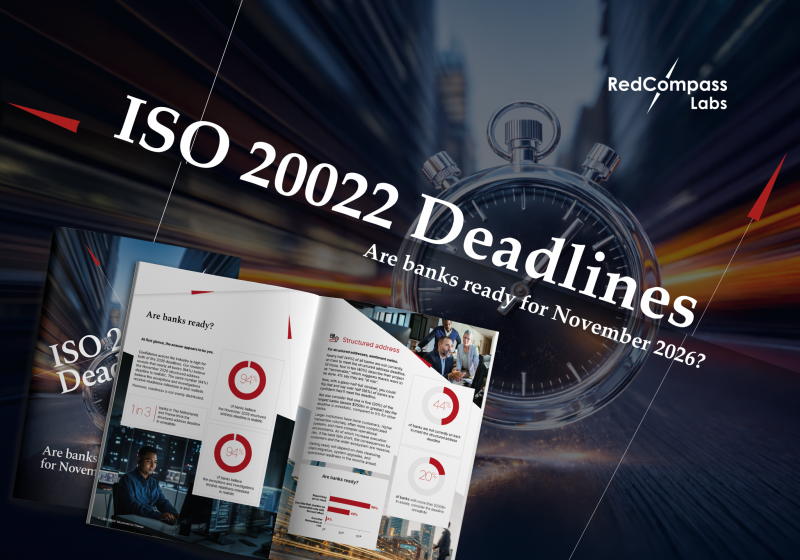
While many acknowledge the scale of change, readiness varies widely. According to RedCompass Labs research, just 10% of financial institutions have launched strategic roadmaps that align payments operations, technology, and data governance. We also found that the other 90% are treating the transition as a series of tactical upgrades rather than a multi-year transformation.
Now is the time to question where you stand, and what meaningful readiness looks like as deadlines approach.
You can’t avoid these deadlines, so banks could do worse than approaching them with a radical change in mind.
The shift to structured data will enable banks to pinpoint issues more quickly across correspondent networks, reduce manual intervention, and accelerate resolution times. ISO 20022 can become a foundation for a more efficient and trusted global payments ecosystem.
This is not a tick-box exercise.
Watch our ISO 20022 webinar
We hosted a webinar in partnership with Finextra and a panel of payments experts. They discussed banks’ readiness for the November 2026 and 2027 deadlines and which strategic initiatives have already been kicked off.
During the session you’ll learn:
- The risk of forgetting E&I when modernizing your payments platform
- What does a successful ISO 20022 transformation look like?
- The most important changes to case management and payment messages
- What are the risks of upgrading E&I systems independently?
You can watch the whole webinar in the video above or follow the transcript, which you can find below.
Speakers:
Scott Hamilton: Contributing Editor, Finextra (moderator)
Pratiksha Pathak: SVP, Head of Payments, RedCompass Labs
Sean Hickey: Cash Payment Product Manager, Mizuho Bank
Scott Hamilton: Welcome to today’s Finextra research webinar. Cracking ISO 20022: Winning the Exceptions and Investigations race to 2027. I’m Scott Hamilton, Contributing Editor for Finextra, and I’m excited to lead the conversation today sporing important insights on that topic with you, our audience, and a fantastic roundtable of experts here.
But before we jump into it, I’ll invite you to first take a moment to download the helpful resources provided for your further knowledge by our sponsor, RedCompass Labs.
We encourage you to ask questions during the session also, and we’ll try to get to as many as we can. And you’ll have a chance to weigh in on two audience polls today. Now, does anybody remember a busier, more challenging time for financial services operations, product, compliance, teams than we’ve ever seen over the past few years? I guess it’s no surprise that the changes in systems, rules and regulations seem to never stop. Of course, that’s the case in much of the greater economy as well. The business world as well.
But the banking and payments worlds stand out even amongst many other industries, because they’re so closely regulated, because it’s so important to the daily productive, safe and secure actions and activities. And yes, the financial security and resilience of just about everyone it touches. And it touches just about everyone.
Once, long ago, there was the standard and it was Swift and it was good. But then it was improved, modernized and simplified in the form of ISO 20022. It took a while, actually decades, before everybody was ready and willing to implement ISO’s sensible new rules. It’s efficiency encouraging enhancements. It’s new approaches to help smooth and hopefully supercharge the speed and processing. And yes, the exception management of international payments.
Now we’re in year 22 since new syntax and structured data formats were first proposed in 2004, to revise the initial Swift message and reporting standards. Now we have MTs officially moving to MXs only last year. Yet as we head into 2027, there’s more. In phase two of the ISO implementation, banks and other financial services, institutions, their customers, must comply with something that may be quite simple, may seem quite simple, but in the real world of international commerce, with distinct regional differences and different customs, might actually be. So those are, we’re talking about addresses for payees.
They must be entered in the proper structure and format, or at least an acceptable hybrid to match the global conventions that will be universally recognized, and not kicked back as exceptions. That’s the mandate coming this November. As for those exceptions and the investigations that follow, when a payment transaction doesn’t go through or something goes wrong in this increasingly 24/7 real-time world, well, there won’t be anywhere to hide for financial institutions that aren’t ready by November of 2027 to comply with those specific new requirements as well.
The clock is ticking indeed, and it is time to get ready. Our esteemed panel will be discussing how banks are or should be encouraged, not just to tick the box to meet evolving industry standards, but also to find ways to make the most of one of the greatest opportunities in decades to speed, secure and simplify global commerce.
Wherever its origins, destinations, or the clients and partners involved. And of course, AI will surely play its own part in all of this. So welcome to our dynamic duo of ready and willing expert panelists today!
Pratiksha Pathak, SVP, Head of Payments, RedCompass Labs and Sean Hickey, Cash Payment Product Manager for Mizuho Bank.
Pratiksha, what does the landscape look like with the coming ISO 20022 changeover to those hybrid full structured addresses, when the, within the banking marketplace?
And with November 2027 E&I changes on the horizon as well, are banks moving at the pace they must to comply? Are their corporate customers, the ones that generate those high volumes of cross-border transactions, jumping on board as they must if we’re going to make a successful transition for global banking and commerce? Pratiksha?
Pratiksha Pathak: Yeah, thanks, Scott. Let me set the scene because I think there’s a misconception we need to clear up straight away. A lot has happened with ISO 20022, but the work hasn’t actually been done yet.
ISO 20022 was launched first back in 2004. It’s actually older than the iPhone, so the standard has been coming soon for longer than some of my colleagues have been alive. We have had more than two decades to get ready, as you mentioned, which, of course is exactly why everyone’s scrambling to do this, this year. But jokes aside, we reached a genuine milestone on 22nd November 2025 at the end of coexistence. But from that date, banks have to send structured MX messages rather than the old, unstructured MT format.
So the industry tends to think: great, we have gone through that. But the first wave was really about the message format and conversion. The next wave, and this is the hard part, is about whether banks can keep structured data clean and intact across the entire payments lifecycle. Which is the customer master records, onboarding and KYC, core banking, payments engine screening, and investigations, and so on.
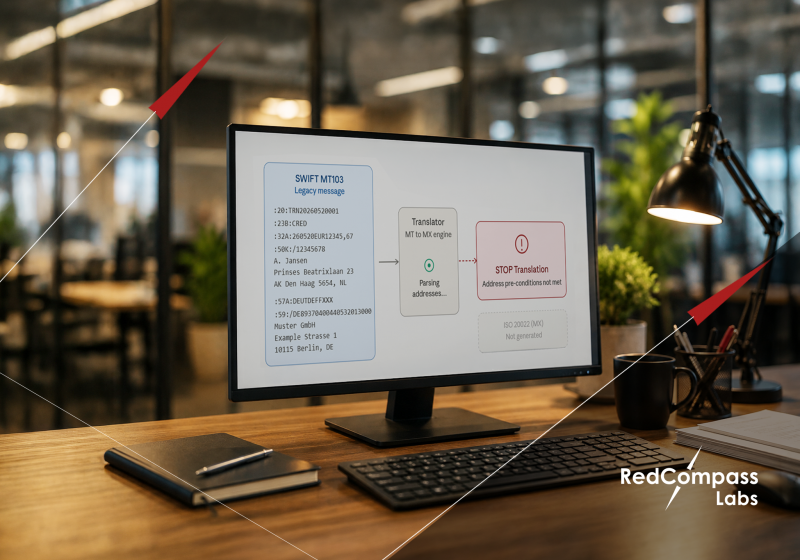
And 2026 is defined by two parallel mandatory changes. First, the structured address migrations from November 2026, wholly unstructured fully address will no longer be supported in CBPR+ messages. Swift and the schemes like Sepa will start rejecting these payments, which carry the fully unstructured data. And the second, the overhaul of exceptions and investigations. From November 2026, banks must be able to receive the new ISO 20022 E&I messages and by 2027 they must be able to send them as well.
So why does it matter so much everywhere now? Two reasons. One, there’s a hard enforcement. If your message don’t follow the rules, the network validates it, affronts and reject it. And the other is the price which is underneath that.
So ISO was always meant to give us a clean structured data so we can achieve more STP, more transparency and ultimately the cheaper and more reliable, reliable payments. That’s the opportunity the banks risk missing if they treat this purely as a compliance tick box. And just to flag the connection, I will come back to later.
These two work streams are not independent. So poor advice remediation directly drives up the rejection volumes, and those rejections then lands into, the straight into, the investigation queue. Treat them separately and you compound the operational pressures which right into the enforcement begins.
And of course, as you mentioned in the beginning of the session, there are some numbers like which came across in the report, the research, which RedCompass Labs conducted. Where it was very significant impacts, which we understood, like one in out of five banks, largest banks, which says the structured address deadlines is unrealistic. Right? Which is, it is like 5% of the smaller bank, which is quite concerning.
And when it comes to the E&I, 73% said that they are fully ready to receive 2026 messages. But 27% partially ready, higher than we expected. But receive ready, It’s just the easy half. Sending by 27 is much harder.
S. Ham: Incredible layout of the situation and also some very helpful statistics.
It is all linked. It’s also a little bit complex. I’m sure the people who are on the ground behind the scenes and banks know a lot of the factors involved, of whether or not they’ve taken action or not. That’s a really good question and how far they’ve gone to make it an opportunity, rather than just that tick box exercise.
Now, Sean Hickey, no more coexistence between, you know, as we just heard from Pratiksha, no more coexistence between MX and MT syntax anymore. Your thoughts on the importance of these address changes, the impacts on what you deal with, the E&I processing volume, the time involved, all these other factors. With your international clients. You know, your bank specifically is mostly international.
Payments in that room can create lots of investigations and exceptions. How are these new address formats requirements going to impact them? How does a bank make sure that their business clients are getting the message of what November 2026, November of 2027 really means, how to get them on board for next year as well as this year. All kinds of questions involved in that.
Sean Hickey: I guess I can start, I would say from my position where working with the online channels, a lot of the focus is on, from the channel into the bank and then forward from there in the processing.
The other thing that banks have to consider is how to get that information from customers in a format that’s worth processing and can be handled correctly. So it’s a matter of managing this transition and the developmental change over time. For thoughts on on things like the exceptions and investigations volumes, I think probably we’re going to end up seeing a spike in those things for a little while.
It’s a matter of that developmental and incremental change amongst customer behavior. And in also for banks learning, learning the processing, learning what customers are doing, re-educating, dealing with the exceptions that are that are coming out there, tuning other systems that are provided with the same addressing information.
So calls to your anti-money laundering or to your sanctuaries, checking how that information is passed will still affect those systems as well. And so you may end up seeing spikes there. Tuning heuristics. It depends on a number of factors in terms of your back office processing there.
So yeah I’d say that that’s something that’s going to probably see a spike for a little while. And then things will settle down to something that we can say is a regression towards the mean, a normalization with the volumes. But in case of getting customers ready for it, probably something I will end up saying a lot is communication is your key. It’s about having a communication strategy with customers to show them what they need to be doing, pursue the benefits with them, show them, demonstrate the benefits.
Let them know the requirements. If there are changes in their behavior, in their processing, possibly in their internal procedures, working with them in order to be able to move them into this new world of the new message formats.
So there’s a fair amount of work to do within a bank but also managing the customer side of it as well, in order to see customers adapting their behavior into something that we can continue to work with, with the new messaging formats.
S. Ham: Thank you for that. For the bank perspective. And I know we’re going to come back to you later and talk a little bit more in depth.
And you’ve mentioned to me in preparing for this webinar that, you know, it just kind of depends on the client, and we’ll talk about that as well. You know, your approach, it’s never going to be a cookie cutter approach.
Unfortunately, a lot of people think, oh, well, let’s we’ll just send out a memo or we’ll just have a series of webinars or meetings with our clients, and it’ll all be just great. But that’s just not the communication has to be specifically oriented towards that particular relationship.
I mean, you can get as much done as you can with a broad brush, but there are going to be needs not only, as you said, for follow up, but also just upfront to do it the right way. We’re going to talk more about that.
But first we’re going to break for our first poll question, which is how confident is your organization in meeting the November deadlines, these requirements? Very confident. You know, our systems are already valid, validated, compliant, fairly confident. We’re on track a little bit of work to do. Concerned, we’re behind schedule.
We’re facing data quality challenges. Obviously data is a huge issue for everyone right now. And, or we’re not confident we haven’t fully assessed the impact yet. Love to have our audience weigh in on that, because that will help us get some perspectives as we move into the rest of the webinar.
Pratiksha, thoughts on the remarks of what we just heard from Sean. And, you know, he’s talking to the banking perspective, which you know very well. And I know you know Sean as well, that it’s basically the internal and external impacts of these new ISO changes. It’s going to, whether it’s just compliance or whether you’re trying to help the customer experience, it’s going to affect that customer experience. And sure, a few examples of how being well prepared for these kinds of changes is really going to play out in these typical bank to client interactions in the real world.
Whether they do it the right way or the wrong way, when they’re entering those payments after November. And then also any regional differences you’ve seen. I know I’m throwing a lot in there, but you have a good idea of how this works in certain countries and also across the globe, because it’s not just it is a global standard, but it doesn’t always work the same way everywhere you go or it won’t be implemented the same. Right?
P. P: Yeah, absolutely. And the especially the customer experience point was very well put through by Sean. Because they, okay. Let me give a concrete failure mode first because it’s worse than people assumed.
Picture a corporate that submits a payment with unstructured address elements. The validation only bites at the very end of the flow when the message hits the Swift network.
But by then, the bank has already done a lot of work internally. It’s debited the customer’s account, run the sanction screening process the instructions, and the message gets rejected later.
Right, now you are unwinding all of that which is being done, refunding the customers, asking them to resubmit their file and explain why exactly that happens. Right. So that’s exactly how a bank loses the customer trust and the confidence. So if you’re doing nothing, all of that can happen. And it’s real.
The lesson is simple, but of course it’s an expensive one. You must have the validations in place at the point of capture or at, and actually, not or, and the point of processing. So before anything goes out of the door, everything should be checked. So the well-prepared bank validation up front and guide the client to build the payments collection at the first time is very important.
The unprepared bank, of course, that discovers the problem after it has already touched a dozen of internal processes, the same payments, completely different client experience every single time, which is not great. And on a regional difference, there’s something I can, of course, I think I did mention in one of my previous webinar, which is of course, something which is coming and I feel very personally about that one.
Because I grew up back in India, in in a city called Golia, and I have been living in London since 2013. Of course, that part is not going to go away anywhere and postal address are one of the biggest hidden differences between the two. If we see in the west, an address runs like house, street, city, postcode, right.
But in India it’s other way round. I’m just taking example from the from the other side, so it often leans on the landmarks literally even where I live. It’s always like near the city mall, near that shopping center behind it, right opposite the bus stops. Past the post office. Yeah, exactly. It’s left to the delivery person to make the interpretation. And I’ve literally seen the addresses recorded as behind the building, as you said right?
When that your data, source data, even having the ISO structured fields in place, they are available. But that doesn’t save you because there’s nothing to clean up to map them into the fields, right? And the framing differs by the market too, which directly shapes how banks should approach the client outreach.
So like in France and Germany, right. Regulatory driven markets, very much, 70% sees that the structured address migration as a foundation of their future analytics and automations. The highest of any other market we surveyed. In the US, that dropped to 52% and worse in Canada, actually to just around 31%. So in Europe, you can sell, this is to the client as a data and efficiency opportunities.
But in North America it’s more often framed as pure regulatory necessity. And the outreach message has to flex to that mindset. Right? I think we also had picked a few numbers from there. So let’s say from the report itself. So, as I said, in each region has its own rulebook to follow. They align to ISO, but of course, they it retained quirks. Hybrid address fields need to be recognized as regionally unique under the new rules, which is going to be implemented.
So like 32% of the bank own the customer address records are still unstructured on average, nearly like 1 in 10 reports, right? 50% or higher numbers. And the 90% of the bank says their sanctions, AML fraud systems are ready. But screening is only as strong as the upstream data is feeding into. So from system point of view, the readiness looks great. But if there’s no clean data, the system readiness doesn’t do anything. It’s just crazy.
S. Ham: There are so many elements to this. I was absolutely fascinating the way you described the fact that it’s not just cleaning up the data, it’s how do you get it cleaned up and who’s going to have to do it? We can’t do it because we don’t even really know the real address, bank, at the bank. You’ve got to tell us and we’ll talk more.
We’re going to talk a little bit with Sean about how customers deal with this, how banks do. But, you know, this is not a simple solution. We’re going to try to give you a few good examples and best practices to share as we go through the webinar. First, so let’s talk about our poll results. The very first poll here was asking you how confident you are meeting the November deadlines for these structured addresses.
Unfortunately, concerned is above the other two. Now if you look at very confident and fairly confident, not too bad. We’re over 58/59%, but still we got 41% of our concerned facing those data quality challenges you talked about. I guess for right now, let’s just go to Sean.
Anything you’d like to add to that? And, you know, we talked about the global nature of your bank. We talked about the way that you have to communicate effectively to clients. But let’s talk about the systems and the processes that are involved.
By the way, when Sean mentioned something, it’s come up. It comes up all the time. It’s almost a joke in the industry, the silos within an organization. Forget about external, but within an organization, how you share information among departments, they actually have to use the same data.
He talked about AML and KYC and also the transaction monitoring. But given the regional differences that Pratiksha just talked about, Sean, I don’t know, any ideas on how you encourage compliance. Maybe some examples, how you dealt with their disparate ERP systems, the locales they operate in, especially if they operate in multiple. I could just imagine if I’m a corporate customer right now, kind of trying to figure all this out based on what I have and what I need to have. A long intro Sean, but love to hear your thoughts
S. Hic: On this process. Yeah. I mean, one of the things in that is what Pratiksha is pointing out, the differences in address systems.
So because we’re a Japanese bank in our headquarters, you see a lot of Japanese addresses. And while they don’t have the down the alley, behind the shopping center quality that Pratiksha was talking about, they do have a larger to smaller build where you’re dealing with the city, the subdivision within the city, the subdivision within that, then a neighborhood, then a building, then a building number.
And they don’t map very well to a lot of the standard North American house number, house numbers, street, city, postcode, kind of formats. So a lot of it is about trying to assess your market and your typical destinations, so that you can redevelop towards the main content that’s going to be required for your customers.
So that’s something, in our case, we’ve had to redevelop the parts of our screens for online payments in order to ensure that customers are allowing us to capture structured addressing, and with the majority of the elements that are required for the majority of our locales and majority of our payment destinations.
Now, stepping back from that a little bit, you have to deal with customers who may within your system, or if you’re developing or introducing a new system, have saved data that they use over and over again.
They have beneficiaries. They have partners that they’ve been paying for a long time. So again, this is another thing that you have to think about as a bank and as an organization, is how much support are you actually able to give customers in terms of migrating that data into a redeveloped system, or if it’s staying within the same system?
How does it map from its current format, which is fully unstructured and in most any order, into something that can be structured? And that’s something that where, you know, you may have to start up a small subproject to support customers as far as possible on that, something that we’ll be looking at reorganizing, cleansing, editing and mapping this data into the target format. Something that can be quite a big project and may require address knowledge from a number of locations.
That may also again step back yet another level, because again, we’re a corporate bank, so we deal with customers doing payments online. We deal with customers doing payments through payment files, and it’s moving customers from what may be older formats, proprietary formats, previous versions of the ISO formats, onto the newer formats.
Now doing that, you may find that they are reluctant to move because they have a method and processes that are built around that. Some of it you may have to, you may have to try and sell on the straight through processing, on the data richness, the smoothness of the process, how it’s going to encourage faster, cleaner, better payments for them. Some of them are going, you may have to do more support.
It may be a matter of negotiating, cost sharing on development that may be required with certain customers, things like that. There are a number of considerations in how you approach customers, convincing them they’re taking a step further back from that. You have a large number of their partners who are not likely to necessarily have been used to providing this kind of information in a certain structure in a certain way.
So some customers may be reluctant to go to their to their partners and say, we need extra information about your addressing or we need certain context in order to be able to fit it into our online banking system and then further down the chain through the processing.
At the same time, those customers may or those partners may or may not be reluctant to hand it over as well. So, you know, you’ve got you’ve got numbers of chains going from the point of capture through the processing, but also backwards through a variety of things out to the original, the original supplier, to your own customer, that is, that needs to be managed to some extent as best as possible.
So, you know, I think there’s an importance in the communication plan there, but also where certain customers need more support, you need to be able to find the resourcing and the time to be able to support them through what development they may need.
Understanding the formats, understanding particular customizations that may be required for your particular individual or financial institution. That’s something that, you know, again, that analysis has to be done internally, but you have to think about those things in order to be able to present them to a customer and get them to move on this path with you as well.
S. Ham: It is not one and done at all. I mean it, you just illustrated how complex it could be. Imagine if every link in that chain except one, was on board and knew what was going on, and youcouldn’t reach them. You know, anywhere along there, you couldn’t get them to respond. I mean, this is a real challenge, and it is going to vary by your client, by their needs and so forth. Let’s look at the results again real quick, Sean, before we hand it over to Pratiksha, So any were you surprised at the numbers from our audience?
S. Hic: Kind of surprised, although I have to say I am relieved aspart of this industry that not confident we haven’t assessed it yet, came in as low as it did. I think seeing any numbers there might have caused a sense of worry. Well, no problem, we’ll hand off.
S. Ham: Thank you for that.We’re going to go to Pratiksha next and we do have some audience questions coming in. We’ll try to address those as we can.
I think there are some questions about, you know, whether hybrid addresses really are going to solve the problem. You know, even though they’re potentially available. Well, maybe some more specifics. Well, team we’ll talk about that in a minute. But first your thoughts on the audience poll that break down and then talk about that balancing act that Sean described where, you know, they need to make these changes.
The banks do, but they also have to get out to their customers how their departments are handling it. One of the things that’s been said when I spoke with both of you beforehand is, you know, you’re going to have to take a deeper dive and get to know your customer, your customers customer, a little bit better along that supply chain.
You know, you’re going to need to get the data. You’re going to make sure they need, they know the data. They need to get you to comply. Everybody complies. Then a straight through processing occurs. First of all your thoughts on the results.
P. P: Right Yes. So these results are actually really telling, right?
And pretty refreshing actually. Honestly if we, as Sean said it’s quite good to look at the bottom option, which is 0% said we haven’t assessed the impact.
So I would say this is not a rule that is sleepwalking into November. Everyone here knows it’s coming. Good. But then look at the top which is like 51% concern behind schedule, especially flagging the data quality. Right. That’s the largest single.
And I think it’s the most honest answer on the board because data quality is the real battleground here. I think we’ve been talking about in this session for past half an hour, because it’s the reality in our research, 44% of the banks, they were not on the track for the structured address readiness. So your rule is, if anything, a little more candid than the market average.
So I will say, here’s the thing. Let’s say I would gently point out to the roughly approximately 30% who said, very confident in your system. Is it the same as readiness? You can be fully validated and compliant internally and still be exposed? How? Because on average, a third of a bank’s client haven’t migrated yet. So that’s the bigger segment also, which needs to be migrated. And at the largest bank it’s nearly half.
So the question I would actually put where the quality, data quality concerns the other 40%, 41% are feeling actually comes from home to roost, which is a perfect segue into the point which I wanted to capture or point out that, that’s where the balancing act comes in. Not just convincing the clients, but the same challenge playing out inside the bank itself. Sean is right about what he said.
It mirrors the client conversation, right? The honest truth is that most banks spent a fortune of money modernizing the payments platform, but didn’t give the same thought to the exception & investigations.
Because E&I was always seen as just manual processing. So you have got to modernize the rails, which are sitting on top of the investigation processes, built on the infrastructure. But that’s nearly 30 to 40 years old. Internally, that means the same payment people are being pulled across the address remediation.
The message changes, the screening logic, the cash management, all at once. And when a hard prioritization comes has to be made. The default is, meet the mandate, bare minimum, nothing more. Let’s do mandatory items first, right?
So the way the better banks handle it governance I would say, are the one who joined up the program rather than doing a lot of disconnected fixes. And here is the worrying number. Around 35 to 37% of the banks are running a single consolidated strategic program for case management reform. And around 60% have multiple real initiatives in flight.
So people read more initiatives as momentum, but it’s more fragmentation. So payments, compliance, operations, technology, each optimizing for themselves with no one actually owning from end-to-end design point of view. So activity actually doesn’t mean your strategy.
So we need to look at the, and now from the opportunity side I will say right, because this is the reframe I would push. If a bank is spending millions running exceptions through manual process across, and I genuinely seen this in 15 different segmented systems.
The address deadline is the forcing functions to consolidate. If we bring it into a single case management capability program, automate the like routine cases, you would free up your best people for the generally complex ones. And that’s where the deficiencies that quietly kills all this STP get designed out. And the benefit lands on the entry level itself, right.
S. Ham: So for the customer, for the bank and for the people who actually work in these systems.
I will say the end of the summary of this whole thing is, look at the programs from the strategic point of view, combine the individual initiatives into a single program, look from end to end point of view, rather just saying I have launched 5 or 15 different projects, which are or the initiative, which are looking at the individual systems readiness.
All I can say is the way you just described it and the way Sean has described it, it’s one. And we do have an audience question that sort of ties into this. It could be the death by a thousand cuts.
If you tried a tick box, this thing, you know, you need to know that whatever work you’re going to do is going to be worth it in the long term. And don’t avoid the work now, because you may have to redo the whole thing over anyway, because you didn’t really address it all the way throughout your organization.
That’s what I hear, hear you saying. And you know, Sean, I know my basic question is how do you manage to complete all this despite all those factors you talked about, and deal with those noncompliant transactions without disrupting the client experience? Boy, what a question that is.
That’s a terrible question because I’m not sure if you know how, but you know, any suggestions you would make. You’ve been through a few questions with clients about these things. You know, ISO was a big move last year.
Obviously, everyone got a little bit trained on having to deal with fixing payments, you know, more than they had. As you mentioned Pratiksha, it’s been going on for many years, maybe the same people, but they’re a little better now than they were, you know, probably a lot better. So what would you do now?
S. Hic: I want to make a point about what partition was just saying with thejoined up thinking, the idea of people being maybe more tactical than strategic and thinking about that and as much as possible, that is true. But I mean, within a bank, a lot of systems will have their own individual life cycles.
And as such, you may find that it’s very difficult to have a very joined up approach to all of your different systems because they may have just started a life cycle or be just freshly into it.
And so developing, upgrading in place or possibly having to develop outside the system that you have translators and joiners between systems, introducing potential points of failure at the same time may still end up being something that you have to cope with.
So I think there may be a best practice, but it’s possible that what we’re aiming for is just better practice. To be as thorough and as joined up on that as we possibly can. So I mean, that’s kind of the one of the big challenges facing banks in general.
Certainly for, for us with our transformations, we’ve had a very large effort going on and has had to coordinate between multiple projects, multiple team holders, or multiple teams and multiple stakeholders, that sort of thing.
So one of the major, again, another time for me to say communication is key. You need to be within an organization, you need to be finding out as much as possible as early as possible. So to borrow from the old Chinese adage about planting a tree, the best time to start is 20 years ago. The next best time is today.
So, you know, finding out if there are things that have been overlooked, approaching other systems, finding out other hidden elements in your payment journey that may still be, need to be addressed is something that is still an ongoing process for, I think, a lot of organizations.
For us, we’ve had an ongoing program for this, for quite a while, and as we near the end of it, as everyone more or less is pushing towards the tape at the end of the run, hopefully that’s all starting to come together for people.
S. Ham: Yes. And you’ve told me in our conversations about that, you feel like you’ve got most of it done. But as you mentioned at the very beginning, there will be more phone calls, more emails, more conversations with specific clients that it didn’t work perfectly.
A lot of our questions are about how Swift case management is going to help with all of this. I’m not sure if any of you want to address it. We’re going to go to our second poll in a minute here. But how is all this going to be helped by any tools that are out there?
Audience. Just so you know, at the very end, I’ve already got it planned, I’m going to ask them, you know, what’s the one thing you would do? So keep that in mind. But within the context of all of this, let’s go to our second poll here. And that’s where we’re talking about those challenges.
What’s the biggest one? Is it that data richness? Is it consuming, mapping that richer structured data? Or is it that interoperability comes up all the time in banking? Now, we haven’t even talked about all the different payment rails and everything else going on.
Banks have had to make lots of transformation happen, like Sean just mentioned. But how do you manage exceptions across a mixed environment where it’s still mixed, or where you’re trying to fix it to not be mixed?
Your service level agreements, your compliance pressure? How do you meet these tighter resolution time frames? That comes up a lot when it comes to instant payments for example. But also with legacy systems that are out there and then that STP, how do we get to that goal, that Pratiksha mentioned at the very beginning, you know, greater STP?
Remember a lot of this is going to be beneficial to payments in general if we get it done right. So audience answer these questions. What’s your biggest challenge?
And we’re going to move on here to the next question. So there you go. Pratiksha, I just asked all that. But it’s really, what are some of the other factors that are coming in? You talked about selling the value, showing the value of doing this, when you’re internally and trying to do this, maybe as Sean mentioned, you’ve done, you’ve got these disparate departments doing their various system upgrades and so forth.
But maybe there’s one that’s holding out. How do you make the benefit, talk about the benefits and say, this is better, we’re going to be more automated for the future. Yeah.
P. P: So I’ll start with 2026, right. 2026 is we all have been talked about that, it’s really the warm up. The deeper challenge, or the change which will come is the 2027 E&I target state.
And it’s the genuine redesign of how payments problems get communicated across the corresponding network. So for context, the traditional MT investigation processes that hasn’t been updated in 40 years.
Think about that. 40 years ago there was no internet banking, right? No mobile, far lower volumes. Today we process billions of transactions every single day. But the way we solve the payments issue is essentially unchanged, how it was in the past.
So the free format workhorses MT199s, MT299s, all the payments geek sitting in, in this call would recognize that, are being replaced by the structured ISO 20022 count flows. And I saw somebody was asking a question as well in in the chat about the camt.110, camt.111.
So I hope that answers as well. Camt.110 carries the investigation request and increasingly support the payments tracing. And camt.111 carries the response, right? And it’s including the rejections. From November 2026. It’s mandatory, the reception of the camt.100.
And within the of course, the flow translation. But by November 2027, it’s also full send and receive through the case management. And I think that was one of the question how useful the case management will be there. Right. So the banks needs now new categorizations and the routing logic where the case management upgrades, operational retraining and the counterparty, like counterparty testing the other side.
And the, crucially, supporting the message format alone is not enough. So your internal processes have to actually interpret and act on the structured data consistently, especially when the teams have always relied on free text and manual judgments.
That’s pretty difficult. And on selling the automation or the outcome internally, I would coach operation leaders to stop pitching it as a system upgrade or new system implementation. And I would rather say start pitching it as a headcount and risk math, mathematics use there. Right.
So the average bank is deploying around between 10 to 12 extra people. Depending on the size of your bank of course, just to deliver these programs. Right. And again, a well-documented shortage of payments expertise. If you do the minimum now, you would literally escape the course. So you just push it into the months after the enforcement, firefighting exceptions and chasing counterparties for data that should have traveled with the payments in the first place itself. Right?
The business case writes itself. For me, when you frame it as every routine case you automate is a person freed for the complex ones, right? And every rejection you prevent upstream in an investigation, you never have to open, actually. Yeah.
S. Ham: Do the work now to avoid it later. Back to what one of our audience members specifically mentioned. Sean,we’re going to show the poll results here, and I’ll first get your thoughts on those, and then we’ll go to our next question.
Well, looks like the biggest challenge, assuming you know the way this reads, what is your biggest challenge when handling payment exceptions and investigations. What does E&I really mean? Well, the largest number of people say it’s achieving that straight through processing, reducing all those manual touchpoints.
You just talked about how much it costs every time you do you do that. But not too far behind is that compliance pressure meeting those timeframes our with legacy systems. I wonder if somehow interoperability people are thinking Swift’s got this figured out. You know, we had a question about specifically how Swift’s going to help.
I kind of wonder where that maybe fits in here. People are thinking we’re going to be okay, or they’re combining it with two. But bottom line is, more than half the people think their biggest challenge is getting, no matter what they do, getting, and I’m sure that will be the case in the beginning.
But down the road, I hope it’s a lot better for everyone’s sake, because the purpose of all of this is to make payments work better for everyone. Sean, I’m not going to you know, you’ve talked about better practices versus best and everything.
We haven’t really talked about the bad ones. We always love to give bad examples in our webinars of, you know, what are the people who did it wrong? We don’t use names, of course, but, you know, we had this one client who never talked to anybody. They went live.
And then all of a sudden the back-office department they never talked to said, what are you doing? You know, so that does happen in even large organizations. Amazingly, I know because I’ve heard about it. But let’s talk about something specifically.
First of all, the results. And then I want to ask you about whether AI can help in any of this, because supposedly AI is great when you’re talking about a whole bunch of data that needs to be quickly parsed and then reviewed by a person. I’ll start with that. Sean. Results surprising to you or not. And then anything about AI that could help.
S. Hic: I think I might be a little bit surprised that straight through processing came out as the biggest concern. To me, I think a lot of the straight through processing leads back to what Pratiksha was saying earlier about data quality. Andmaybe links in a little bit what I was saying about how you organize the data capture in the first place, and that that should lead to better straight through processing.
Hopefully. I kind of read the two middle options here, but interoperability and legacy systems, so sort of tie those together. In that if you have legacy systems you clearly are going to end up with, with interoperability issues and the need for translators or other ways of fixing that. And again, that may tie back to the idea of being strategic in your planning for your systems.
But also some of the things that I’ve said about things being at either a key legacy system that you can’t update, or what I was saying earlier about being at a the wrong point in the lifecycle to really address directly, immediately.
So I think, you know, I think that it’s not too surprising that data riches came at the bottom, but I might be a little bit surprised straight through processing was your top one. Definitely for, you know, certainly in my position the working on all the systems is definitely the, the key pressure on us coming up towards November. AI.
I’m going to say that probably I’m a little more skeptical of AI and its uses than Pratiksha. We have had this discussion previously as well. Sorry, sorry to drag the personal into that Pratiksha, but I would say that there are probably use cases for AI within the system, especially in terms of address and data quality, and having it be able to parse information that doesn’t look right or isn’t of good quality, but possibly also being able to access outside resources and verify things so that it could possibly, for example, rewrite what we have.
The issue there, I would say, is that my personal preference for where the technology is generally now, is to have some manual intervention or manual check on that, simply because there are some issues with data quality within AI as well for general reputation.
But I think as the technology develops, it’s certainly going to be something that’s more useful in terms of that part of the payment processing. But also to the side processes that we’ve touched upon here and there about KYC, AML, sanctions checking, being able to verify, look for patterns that maybe people wouldn’t spot and be able to maximize the positives and minimize the false positives in that.
S. Ham: Yeah, no, that’s a very honest, honest answer. Pratiksha, we’re going to get to you in a minute on this. One of the things that that I was trying to point out is that whenever people have said whether they are fans of AI or not or actively involved in it, they say, hey, it just it allows us to go through a ton of data that would take people longer to do it, then still needs to be reviewed.
And I think you made a really good point there, that if you could have a good system that would pull up, you know, this is wrong because and here’s what it probably should be. You could have at least a shorter list for people to go through. Hopefully it would catch all the bad ones. That would be my idea.
But Pratiksha first, your thoughts on this. I know you’ve already shared a lot of stories on, you know, from both from the bank and the clients point of view, the bank’s clients point of view of smart ways they’ve either put this in place or could.
But you know, anything else you’d like to speak on the AI front, on the technical details or variations, you know, journeys from coexistence to, you know, from the old to the new? Let’s do that. And then we’ll after that, we’ll get towards our last couple of questions.
P. P: Yeah. I’ll start with the poll response, because I love the results, because the room has gone straight to the heart of it. Right. The 50%, 54%, actually, a clear majority said the biggest challenge is, is the STP reducing manual touchpoints and the cost. And notice what didn’t win data richness, the technical can we map the fields question come last at the 8%.
So this audience isn’t worrying about the plumbing. They are more worried about things the plumbing is supposed to deliver. If you add STP and the next one together, which is the your compliance pressure at 25%, it’s nearly 80% of the room is pointing out the same place. Operational efficiencies and resolution speed against the legacy systems.
That’s a real story of E&I. Right. And that’s why I’m more excited. So here’s why it matters. Because STP processing was the whole point of ISO. Clean structured data so case resolve themselves instead of landing in someone’s desk. Which you only get, you only get that if every upstream passes the clean data forward and compliant payment engine can only forward what it receives.
So the 54% of who picked up the STP are right to what the lever isn’t into the investigation team. So it’s quite an interesting numbers, but I’m not surprised to be honest at all. I actually am quite in line with this. But I really wanted to touch upon the the technical variations to flag out for the audience, the migration strategies and the generally the mix about a third which are using the manual interventions or the manual remediation, which is like 34%.
A third vendor led automation 33%, and AI based conversions like 32%. So I will say it simplifies the risk knowing the very customers you are trying to retain. The other, I will say that take leverage this as an opportunity. As I mentioned earlier, look at this as a whole exception and investigation.
How you kind of solve the underlying data, which is sitting in the middle, which actually flows into the overall end to end landscape. So I would say, look, this is a more as an opportunity, what can be achieved and how you can how you can improve your payment engine, which is fully ISO compliant, but it can only forward what it receives, its structured addresses fields doesn’t exist.
Of course, if it’s inconsistently populated, nothing can be done in core banking or onboarding systems. Your end to end data integrity will be gone. Right? And your screening engine, it just inherits the same weakness. So nothing can be done. It’s really an opportunity.
I will say look from the end to end landscape of view and how that data can the rich data can be flow through one place to another place. And that of course automatically feeds into how do you improve your exceptions & investigations manual processing. That’s just
S. Ham: Sn excellent I mean, I hope people really picked up on what you just said. And by the way, there’s good information on your website and in the documents that you have available for download. You actually referred to, you know, a lot of numbers that people are probably wondering about in some of our questions from the audience, but it really comes down to if not now, when? When are you going to do this?
I mean, you’re probably going to need it. Do it anyway, just a higher straight, straight through processing. Now ISO is telling you, you have to do it. So what better now to take that opportunity? Now let’s get to the final question, which is really what do you prioritize?
You’ve got a lot of priorities just within this particular area though. Within the ISO compliance. What would you prioritize now? What would you do to move beyond that box ticking to really making this an opportunity, or any key ingredients to address a particularly challenging part of your organization?
Maybe based on what we heard in the polls, to make the most of this required in this opportunity to deal with the new ISO requirements and the first stage and second stage is those E&I processes. We’ll start with Sean, final thoughts here.
S. Hic: I’d say one of the final things is that when we deal with the ISO messages, we’re dealing with that data richness and we’re dealing with a far greater amount of information and better use cases, newer use cases for a lot of our products.
So hopefully what people are doing, getting beyond just the implementation of this, is they’re looking at how these messages can be used in other products, that they can develop other services and develop, but also understanding the customers and their behavior better in order to be able to to address concerns, to identify needs and wants from the customers so that we can provide better value to them.
So the initially, I think this is going to be something that takes a while to gain any ground, because the creativity that comes with how you use these things and how you use that information doesn’t start on day zero, but it builds over time.
And as people come up with ideas, they come up with new ideas and it’s snowballs from there. So some of it may be thinking about how you can gather decent management information out of your payment engines and out of your sanctions and KYC, and that in order to put together this fuller picture.
And then be able to use that to say, oh, customers actually need something that does x, y, z that we haven’t thought of before and use that information to start pulling it together into something that elevates the services that you’re offering and elevates the customer experience.
S. Ham: Excellent, Sean. And Pratiksha take us home now here that priorities right now
P. P: What do you prioritize. What’s the key ingredient to really make the most of this opportunity and not just tick the box for banks and by extension, for their customers? Yeah. If I had to pick one thing, I’ll say get your data in order at the source and govern the whole thing as a single program.
It’s very key, not a pile of separate fixes, like literally the one ingredient that matters the most first and ongoing is the coordination, the coordinated governance, the structure, investigations. That doesn’t sit inside one function.
That touches the address remediation, screening logic, case management, routing rules, client interactions, the communication, and like literally all at once without one owner pulling those together, you get duplicated efforts, misaligned validations, and the control gaps. Only a number of the percentage of the bank have the single joint program today.
I would say I hope that the gap would close soon. First, and my closing thought for anyone who’s watching, I’ll say. Don’t treat as just another regulatory date. You might clear the bar and then spend the following months firefighting problems you could have designed out now.
So the banks that uses the window to clean their data, that test end to end with their counterparties and tighten governance before enforcement begins, are the ones who will come out as other side quite strongly.
So ISO was meant to make payments cleaner, simpler and more automated for the institutions. I would say that aim beyond compliance and not just the tick box, it’s a competitive advantage. So that’s the real deadline to November 2026 to fix the data. But the bigger price is waiting in 27 and beyond for the banks who’s going to do it properly.
S. Ham: Thank you.There’s there’s the challenge and there’s the prize. You both have done a wonderful job. I want to thank my two panelists, Pratiksha Pathak and Sean Hickey.
Want to thank you, our audience, for joining us for this session. This is real. It’s coming. There’s lots of information you can download or reach out to these two folks to talk to them about their expertise.
I want to just say next you can watch this, send it to your friends or your colleagues. They can watch us on replay. And for now, I’ll just say I’ll give you back the rest of your day. Thank you. Thanks for coming to this Finextra webinar. We look forward to talking with you soon. Have a good day.