
Article
6 min read
The hidden cost of ISO 20022 messages
Migration was only ever the first invoice


The consequences of missing the structured address deadline are wide-ranging for the international banking ecosystem.
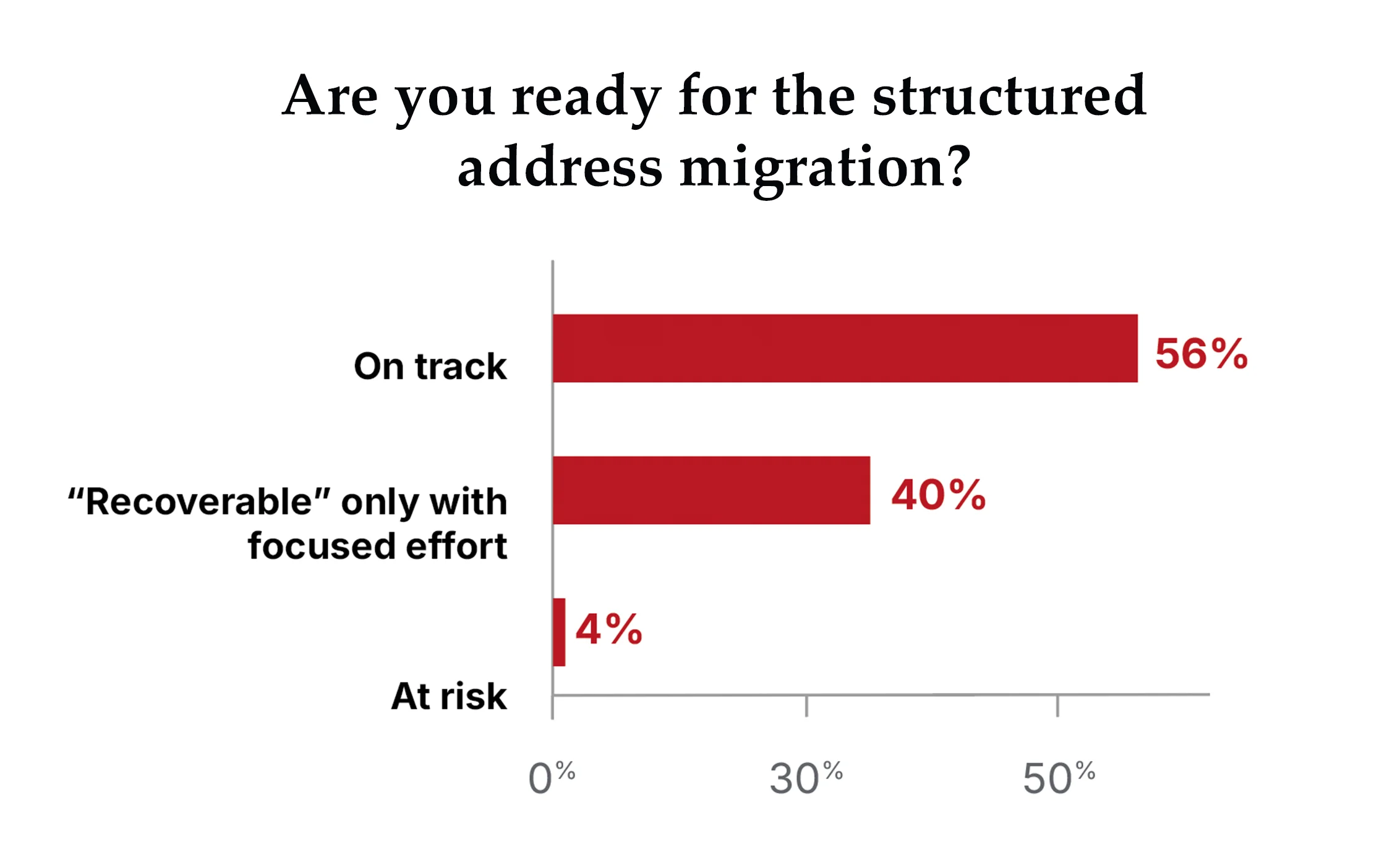
44% of banks aren’t on track to meet ISO 20022’s structured address migration deadline.
You could see this as ‘glass half full’ and calculate that it means more than half (56%) are confident of meeting the deadline. But 44% is a significant chunk of global banks.
The data from our latest research found that of those not on track, 40% see their projects as “recoverable”, which sounds promising, however that depends on what needs “recovering” at this stage. There may be multiple workstreams that that need to be reconciled in the time before the deadline – which is easier said than done.
There’s more concern for larger banks too. 20% of institutions with assets of $250bn or greater, say the deadline is “unrealistic”.
These are the organisations with more customers, higher numbers of transactions and more complex systems. They also have more at stake if payments start to get rejected.
With the November 2026 deadline looming, there’s plenty of work still to be done.
Source: ISO 20022 Deadlines – Are banks ready for November 2026?
A sizeable proportion of banks’ major systems do not yet support fully ISO 20022 structured address fields:
…are not ISO 20022 compliant.
With regulatory deadlines approaching, most banks have a long way to go. Payment engines are the furthest along – 45% support structured addresses – but the majority are still not compliant. With core banking and onboarding and KYC systems also lagging, this creates a further complication.
Even if your payment engine is ready, it can only work with the data that it’s fed by systems further upstream. If banks haven’t upgraded core banking applications payments will fail no matter how compliant the engine is.
Source: ISO 20022 Deadlines – Are banks ready for November 2026?
Being ready for November isn’t just reliant on the banks modernizing their own systems. The customers have a part to play as well. They need to confirm, update and maintain their own payment data.
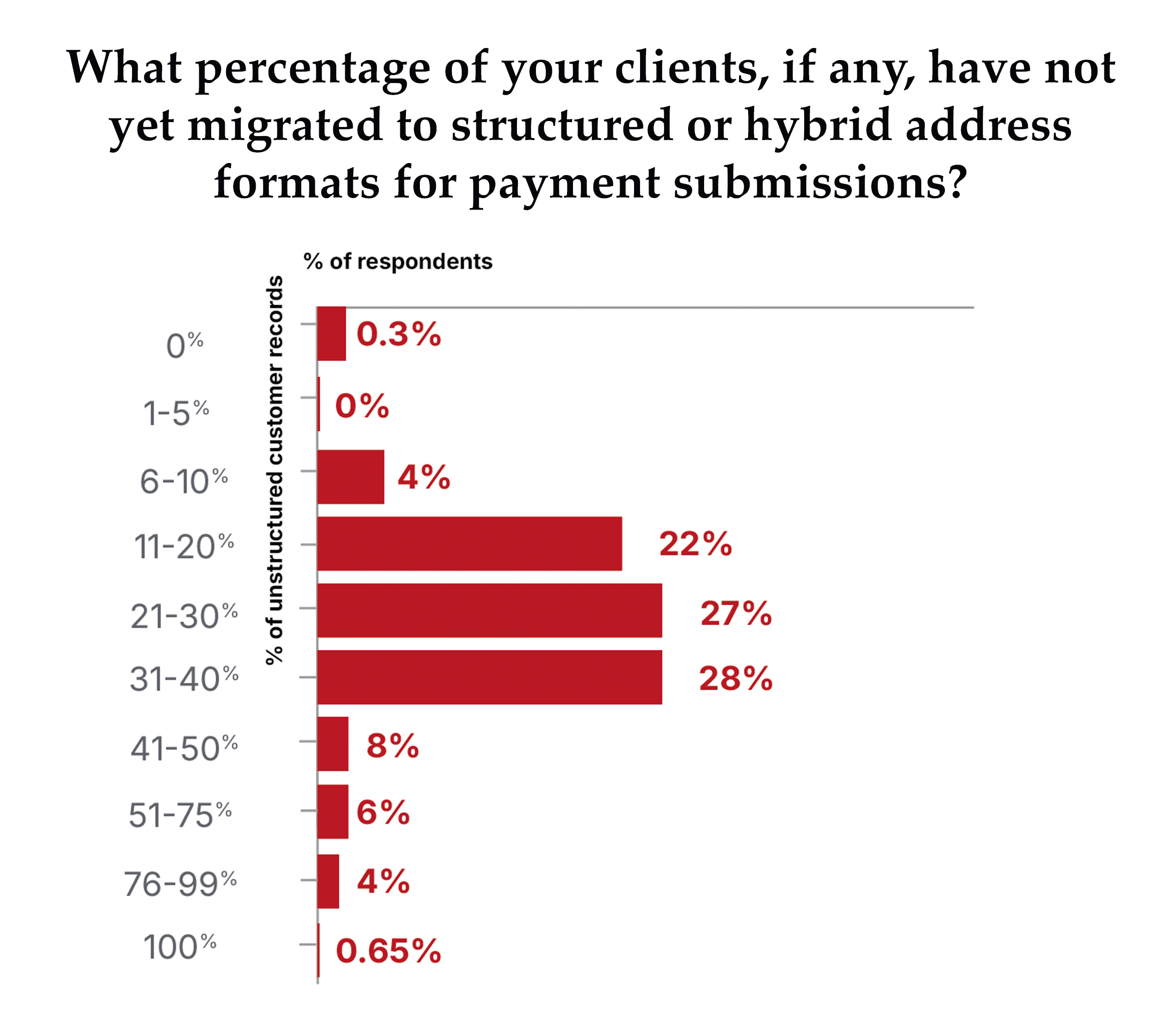
Our data shows that, on average, 32% of an institution’s client base still needs to migrate. This figure rises to 48% among the largest banks. There’s no dominant strategy to transform legacy unstructured data either.
With a near-even divide between manual remediation (34%) and AI-based conversion (32%), there’s a split between methods, both of which come with their own pros and cons.
Manual transfer suggests financial institutions are exercising caution and control, but it’s expensive and time-consuming. Conversely, automation will speed up the process but creates possible compliance and data quality risks.
But no single approach dominates and banks are blending methods. 23% are putting the onus back on their clients – asking them to redo their KYC checks.
This could be a risky strategy, because it’s the banks who are bound by the November deadline, not their clients.
Updating the significant proportion of unstructured address data is not a straightforward process.
Rather than being a case of updating information in a single place, the task will involve multiple systems. The data is likely spread across onboarding platforms, CRM (customer relationship management) environments, legacy archives, payment engines and screening tools.
Corporate clients send payments through these banks using their own systems, which are typically ERP (Enterprise Resources Planning) platforms or TMS (Treasury Management Systems), which still generate payments using free-text and unstructured address fields.
If the client data arrives and doesn’t comply with ISO 20022 regulations, the bank being compliant don’t really help the situation. It’s similar to the issue we highlighted earlier around core applications: if the upstream data isn’t structured or hybrid then there’s an issue beyond the bank’s control.
Technical compliance is necessary for meeting the November 2026 deadline, but it’s not the only factor involved.
To meet November 2026’s deadline, there are two distinct factors that financial institutions must understand – being technically compliant and operationally ready. A bank can meet the deadline on paper, there’s still a real possibility of facing rejected payments and unhappy clients.
So, in the lead up to November, the question you should be asking isn’t “are our systems ready?” but “is our payment ecosystem ready to be tested at scale?”
We surveyed 308 senior payments professionals across Europe and North America about their ISO 20022 readiness for 2026 and beyond.
As well as focusing on structured address migration, the report also explores the challenge of overhauling exceptions and investigations handling.
Share this post

Pratiksha Pathak
SVP, Head of Payments, RedCompass Labs
Migration was only ever the first invoice

Postponing by two weeks gives T2’s address rules a grace period, not a rewrite

Not so long ago digital money was written off as a niche experiment, irrelevant to mainstream…
Gated content

SR 2026 has been postponed until 2027

MT 101 is ending. Here’s what to do before the switch to pain.001

Everything you wanted to know about E&I, but wasn't covered in our webinar

Banks have until 2027 to move exceptions and investigations to ISO 20022

The clock is ticking...
Gated content

Fully unstructured addresses will be phased out in November 2026

Meeting new data, messaging and operational demands

Europe's payment engine is taking a major step towards ISO 20022 alignment.

Banks face two major ISO 20022 deadlines in 2026. Will they meet them?

Fedwire, CHIPS, and Swift (CBPR+) are all moving on the same timeline.

Payments are evolving faster than many banks can respond

Gated content

Here's everything you need to know about ISO 20022 for the foreseeable
Think your ISO 20022 journey is almost over? Think again.
Gated content


Swift has provided a range of support options for contingency planning.