
Article
6 min read
Why payments needs applied AI
We need SLMs steering LLMs to build new payment flows


With the release of our new Payments Expert Agent, we explore what makes Vertical AI solutions so powerful.
Key takeaways:
There are more potential variations in a single ISO 20022 payment than there are atoms in the universe.
Hard to believe, isn’t it? But it’s true.
The dense network of metadata, rules, and interlocking systems that make up a single payment demands a level of precision—and a tolerance for complexity—that few other domains can match.
AI can help to make sense of it all, but not all models are useful.
Take, for example, general-purpose (or ‘horizontal’) AI, such as ChatGPT. ChatGPT has wowed the world by performing open-ended tasks, but it struggles in specialized fields like payments modernization. Yes, it recognizes terminology and can predict answers with some precision. But it currently lacks the structured logic and decision-making frameworks to make it useful for complex problems.
Even if future advances address this shortcoming, general AI solutions will continue to lack information hidden behind firewalls. They’ll also miss the ‘dark matter’ of the subject matter expert (SME) world: the 99% of knowledge and tradecraft that lives in an SME’s mind – not contained on the internet.
Vertical AI, on the other hand, taps into the minds of subject matter experts to provide highly accurate, dependable answers. But what is Vertical AI? How does it work? And how can we apply it to payments?
Vertical AI are specialist AI systems designed for and applied to specific, complex industries. Vertical AI models don’t just generate text or summarise information. They capture explicit knowledge (rulebooks, standards, system intricacies, etc.). And implicit reasoning (cognitive processes, decision-making, understanding of nuance, interdependencies, and edge cases). To think like an expert.
So, how does it work? Vertical AI builds on top of existing large language models (LLMs), such as OpenAI’s GPT, DeepSeek, etc, by adding a layer of domain-specific expertise. Think of it like fitting a high-precision lens onto a powerful camera. It sharpens the focus on payments, enabling the AI to reason with industry-specific knowledge and handle complex, nuanced scenarios.
One such model is our Payments Expert Agent – a Vertical AI solution specifically designed for payments modernization projects. Payments Expert Agent doesn’t just generate text; it applies expert reasoning, aligned to the structured logic of a payments expert.
Payments Expert Agent has been created with:
By combining these components, the Payments Expert Agent is trained to reason, think, and behave like a payments analyst.
To understand how it works, let’s explore these concepts in more detail.
Pre-training provides foundational knowledge for a model. Fine-tuning takes it a step further by embedding domain expertise at a deeper level. We apply this to the Payments Expert Agent using a hybrid approach:
This boosts accuracy, drastically reduces hallucinations, and delivers better contextual awareness compared to generic LLM fine-tuning approaches.
For example, the Payments Expert Agent benchmarks 13% higher in output accuracy, quality and completeness for payments-specific tasks when compared to Chat GPT-o1.
Continued pre-training is the process of further training an already pre-trained foundation AI model on additional domain-specific data to extend its capabilities or align it more closely with specific domains. It’s resource intensive. And, it needs to be done each time the foundation model for the vertical AI solution is upgraded, or new approaches to payments modernization are discovered.
Payments Expert Agent undergoes continued pre-training using every rulebook, standard and regulatory update in the world ensuring:
This approach ensures the model can perform highly specialized tasks, far outpacing foundation models. As one measurement of domain specificity, the Payments Expert Agent’s domain adapted model achieves perplexity scores ten times lower than the foundation model when tasked with payments-specific work.
Having such a large pool of documents enables the Payments Expert Agent to be comprehensive, but it also creates a challenge in ensuring the most relevant and accurate documents are referenced when performing complex tasks.
Taking a proprietary and specialized approach to Retrieval-Augmented Generation (RAG), tailored specifically for the payments industry, significantly enhances the accuracy, completeness, and reliability of AI-driven outputs.
the Payments Expert Agent’s agentic retrieval framework integrates multiple retrieval mechanisms including, Hypothetical Document Embeddings (HyDE), Multi-query retrieval, Named Entity Recognition (NER), and lexical optimization – all of which have been fine-tuned for the payments domain.
These sophisticated retrieval mechanisms ensure that the data the model uses to generate its output are contextually precise and domain-aligned. The Agentic Retrieval Framework consistently retrieves highly accurate, verifiable information, ensuring outputs are not only well-referenced but also practically actionable for payments teams.
By prioritizing domain expertise over general knowledge, the solution provides deeper, context-aware insights that align closely with real-world payments processes, standards, and regulatory requirements.
As a result, the proprietary agentic retrieval framework provides payments professionals with trustworthy, comprehensive, and error-free outputs, minimizing risk in critical modernization initiatives.
One of the greatest challenges in AI for financial services is capturing not just what experts know, but how they think. Cognitive Task Analysis (CTA) solves this by dissecting how human subject matter experts think, reason and make decisions.
By combining the payments pre-trained model with ‘cognitive architectures’, the limitations of one (for example, payment-specific knowledge but no understanding of how to interpret rare or unusual scenarios) are complemented by the strengths of the other (the understanding that A could be interpreted as XYZ). CTA involves:
By embedding these reasoning pathways into the solution, the Payments Expert Agent avoids the pitfalls of purely statistical AI models that can only parrot surface-level information.
Instead, the AI has data about the “why” behind payment modernization projects. It doesn’t just recognize patterns in payments language but understands the reasoning behind decisions.
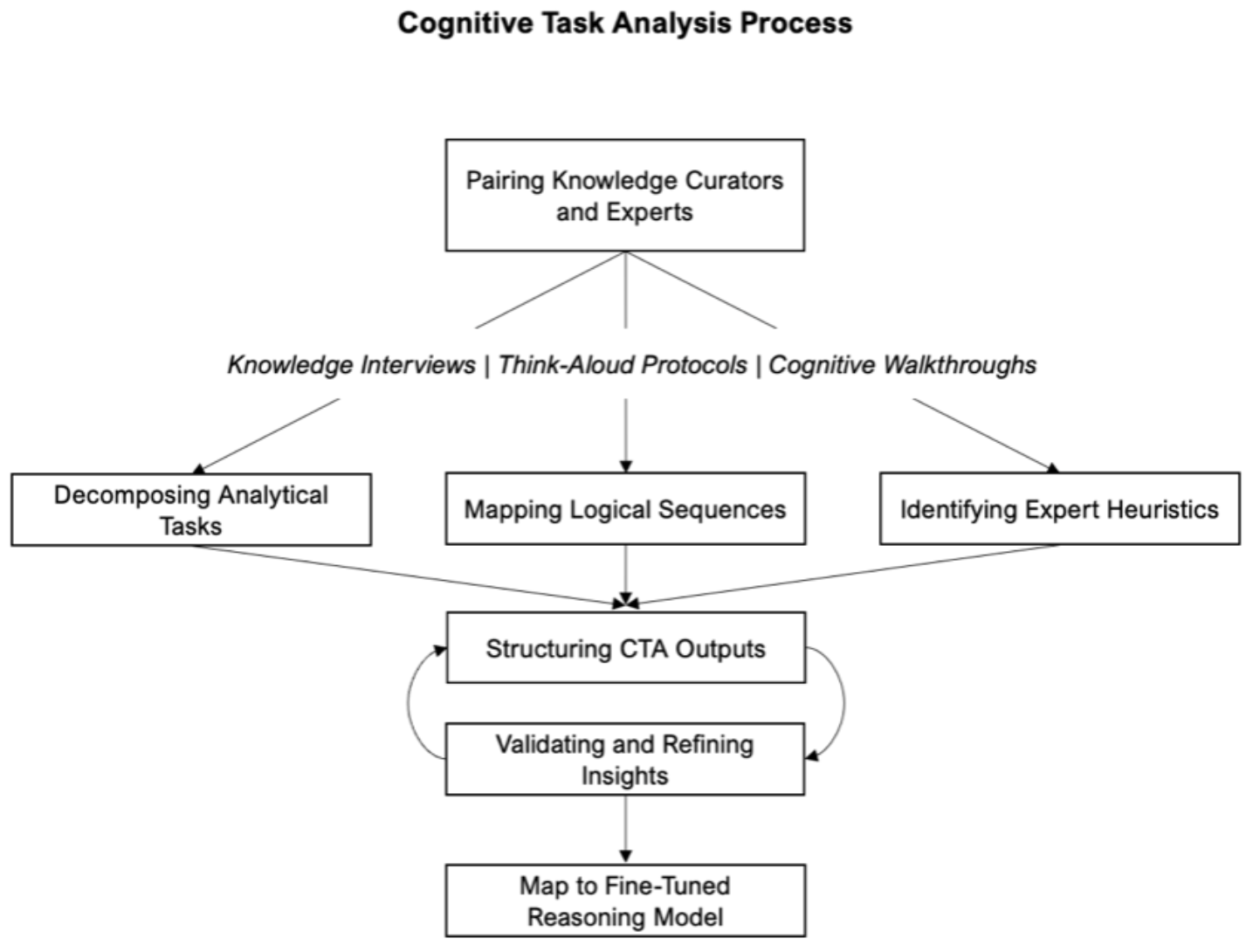
(Image: A simplified view of the CTA process)
Generic AI models will always fall short in high-stakes, deeply regulated environments like payments. Vertical AI, on the other hand, is a true accelerator for financial institutions navigating the complexities of payments modernization.
If your bank is facing payments system upgrades or regulatory challenges, now is the time to leverage expert-driven AI. Unlock the full potential of your payments team with a breakthrough solution that doesn’t just deliver the generic —it reasons, advises, and drives real impact.
Curious about how RedCompass Labs and the Payments Expert Agent can support your payments modernization journey?
Share this post

Alex Henry
Head of Product, RedCompass Labs
We need SLMs steering LLMs to build new payment flows

What vendors, banks and systems integrators must do next

Nobody wants to say it: payments complexity exceeds...


We once trusted humans to type payments over telex.









The payments industry is no stranger to transformation, and today...

AI helps banks modernize payments faster.