Article
6 min read
The hidden cost of ISO 20022 messages
Migration was only ever the first invoice


Turn ISO 200022 rich data into a real advantage with our latest guide. Download yours today.
The global financial system is changing. Soon, ISO 20022, a messaging standard designed to improve how payments are processed and communicated, will become the global norm.
ISO 20022 messages support richer, more structured data than their predecessors. Built in XML, they’re both human and machine readable. That makes them flexible and easy to use.
These richer data fields enhance everything from anti-money laundering checks to straight-through-processing (where payments pass through a system without human intervention – the holy grail for payments processors and customers).
Better data opens up new business models and products for banks. And it can speed up the payment process, reduce discrimination, and improve the payment experience for millions of people.
However, not all data fields are created equal. Some deliver more immediate and tangible benefits than others.
Take, for example, the pacs.008 message. Commonly used for credit transfers, this message typically contains over 900 fields (both mandatory and optional). However, the actual number populated will vary depending on the use case, regulatory requirements, and system configuration. In practice, a typical payment message may only make use of between 50 and 150 fields, depending on its complexity.
* The precise count may differ slightly by version or how subfields are tallied.
Rich data fields
Understanding which fields to prioritize, then, is essential to unlocking the full value of ISO 20022. By focussing on high-value fields, businesses can streamline financial processes, pave the way for automation, and gain insights that were previously difficult to extract.
To fully leverage these richer data fields – to turn them into operational and strategic advantages – you must have the right systems and workflows capable of capturing, processing, and leveraging these fields effectively.
That is why we have created this guide.
In the following sections, we will explore the most important fields in ISO 20022 payment messages. We’ll cover everything from Structured Remittance Information to Purpose Codes and Structured Addresses and explain how you and your customers can make the most out of them.
We’ll provide the context, benefits, and opportunities for each field. By the end of this guide, you’ll have a far richer and more nuanced understanding of ISO 20022.
Share this post

Praveen Bhosale
Senior Business Analyst, RedCompass Labs

Arun Kumar Saravanan
Senior Business Analyst, RedCompass Labs
Migration was only ever the first invoice

Postponing by two weeks gives T2’s address rules a grace period, not a rewrite

Not so long ago digital money was written off as a niche experiment, irrelevant to mainstream…
Gated content

SR 2026 has been postponed until 2027
MT 101 is ending. Here’s what to do before the switch to pain.001
Everything you wanted to know about E&I, but wasn't covered in our webinar

Banks have until 2027 to move exceptions and investigations to ISO 20022
The clock is ticking...
Gated content
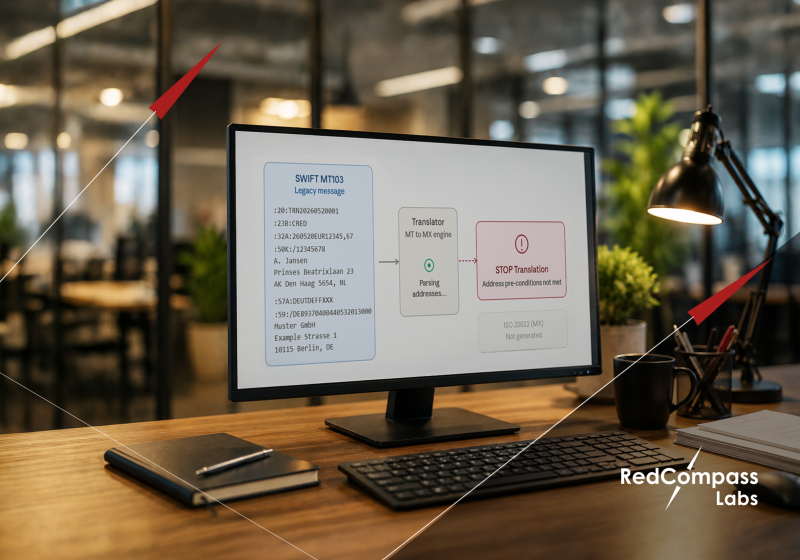
Fully unstructured addresses will be phased out in November 2026
Missing the deadline has wide-ranging consequences for the banking industry

Meeting new data, messaging and operational demands

Europe's payment engine is taking a major step towards ISO 20022 alignment.
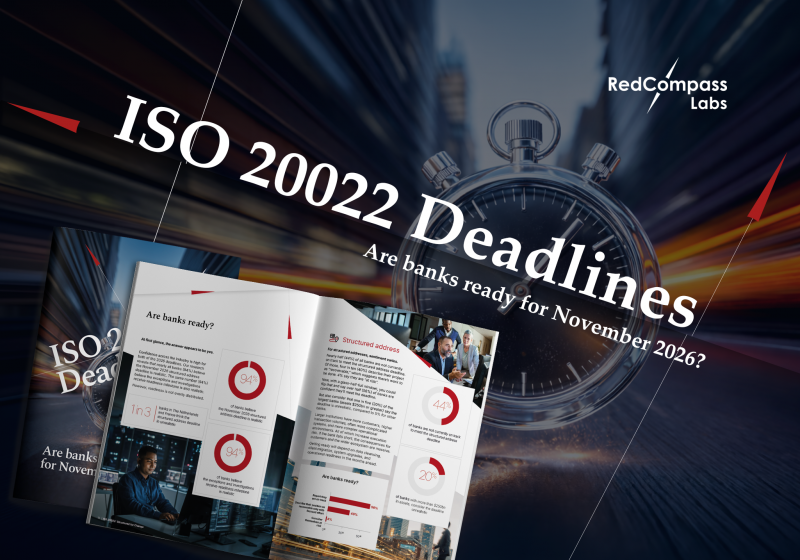
Banks face two major ISO 20022 deadlines in 2026. Will they meet them?

Fedwire, CHIPS, and Swift (CBPR+) are all moving on the same timeline.
Payments are evolving faster than many banks can respond
Gated content

Here's everything you need to know about ISO 20022 for the foreseeable
Think your ISO 20022 journey is almost over? Think again.
Gated content