A lot of the focus on digital money centers on infrastructure and integration. Groups of banks are building their own stablecoins or tokenized-deposit networks. One of the biggest sticking points for adoption is concern around interoperability. There’s a question of whether the industry is simply replacing one form of friction with an updated digital version. This frames the conversation as a technology or payments story.
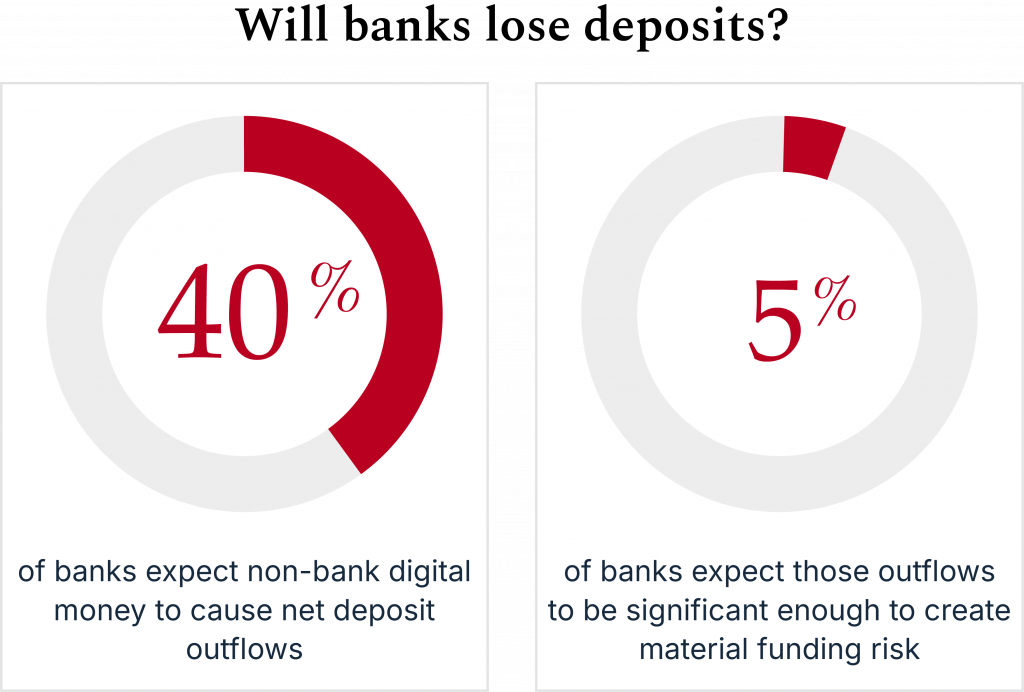
But what does digital money mean for balance sheets? Our latest research found that four in ten banks (40%) expect non-bank digital money (e.g., third-party stablecoins or tokenized money-market funds) to result in deposit flight over the next 3-5 years. Senior banking leaders recognize that these new forms of money could impact their liquidity.
Deposits are a cheap and reliable source of funding for banks. What happens when customers start moving them elsewhere?
Where will the money go?
When money is transferred into a customer’s account, it doesn’t sit in a big vault until it’s needed again. Banks add the money to their balance sheets. This is then used, in part, to lend out as mortgages, business loans, or lines of credit.
If that same money leaves the bank and moves into a stablecoin wallet, the wallet issuer holds the cash in short-term government debt, in repos, or in deposits at other banks. So, it’s still in the system, but no longer on your balance sheet, which means less cash for mortgages, loans, and lines of credit. And what does come back tends to be large, concentrated, and quick to move.
Four in ten (40%) banks expect deposit outflows, though most expect them to be modest. Only 5% of all respondents expect outflows large enough to be a material funding risk.
Whether that’s how it plays out will depend on how stablecoins are used. Customers holding stablecoins for a short time to complete a payment won’t have a significant impact on deposits. But if balances are held for longer, as working capital or a store of liquidity, then this could cause a larger issue.
There’s a less obvious risk too: the quality of deposits that stay on your balance sheet. Picture a corporate treasurer who leaves $50 million in an operating account and barely thinks about it. If this happens in a 24/7, programmable world, that same treasurer can easily sweep the balance every evening to wherever it earns the most. Then bring it back the next morning. At the end of the month, the deposit number looks the same.
A useful way to picture the change is cars. Deposits used to be like a classic car, valuable and parked in the same garage year after year. Now they’re more like an Uber, always on the move and heading wherever the best fare is. That makes it far less reliable for funding.
Banks are split on how to react
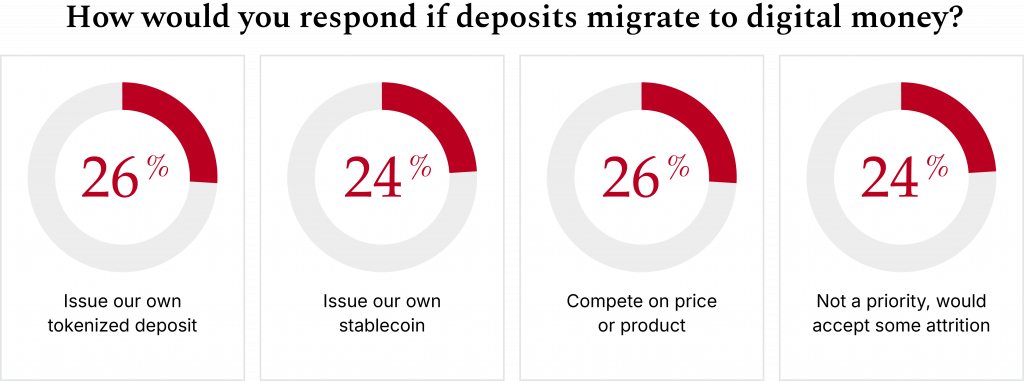
There’s no consensus on how institutions would adapt if deposits started to migrate. Half (50%) would issue their own digital asset, with a near-even split between tokenized deposits (26%) and stablecoins (24%).
On a balance sheet, these two digital assets behave very differently. A tokenized deposit is still a deposit, with the same liability and still available to lend. In contrast, a bank-issued stablecoin must be backed one-to-one by ring-fenced reserves. That money can’t be lent out. So, one option keeps the funding, the other keeps the customer, but not necessarily the ability to lend against their money.
Other respondents would take a different approach. Nearly a quarter (24%) don’t see the issue as a priority and would accept some attrition. The remaining respondents (26%) would look to compete on price or product rather than tokenize the money in any form.
So there are three possible courses of action that banks expect to take:
1. Resist
Try to keep the deposit from leaving in the first place. Offer incentives such as preferential rates and lower friction that encourage customers to keep their money where it is. This may cost less than building new infrastructure, but it is the option least likely to succeed against digital money’s speed and 24/7 availability.
2. Accommodate
Accept that some deposits are likely to migrate and don’t fight it. That’s what nearly 1 in 4 banks expect will happen. If the outflow is minor, then defending against a small and uncertain risk may not be worth the time or the effort. If usage patterns shift and customers start to hold stablecoins rather than use them for transactions, the risk of choosing to accommodate grows.
3. Build
If a bank builds its own stablecoins or tokenized deposits, then customers who want programmable, instant money don’t need to go elsewhere. Half of the banks we surveyed expect to take this route. This is by far the most expensive of the three options because it involves building new infrastructure and implementing compliance measures. But it’s also the only option with a real upside. Nearly three in ten (29%) respondents expect non-bank digital money to bring a net inflow of balances rather than an outflow. Those are the banks positioned to offer the instant, programmable money that customers want, rather than watch them find it elsewhere.
Pricing in the risk
Some regulators are building rules to combat the risk of deposit flight. The Bank of England’s June 2026 draft rules for systemic sterling stablecoins allow issuers to hold up to 70% in short-dated gilts, with at least 30% held by the Bank of England, earning nothing. Each systemic coin also faces a temporary £40bn issuance cap, a guardrail that limits how fast deposits can migrate while the market beds in.
Europe is approaching the same problem from the opposite angle. Under MiCA, a large share of stablecoin reserves must sit as deposits at banks. This turns that money into large sums that can leave quickly, making it a less dependable source of funding for the banks that hold it. That rule is now being revisited. While the UK is worried about deposits leaving banks, the EU’s concern is what happens when they arrive.
Looking past the plumbing
Conversations around infrastructure are bound to dominate the introduction of any new payment rails. The balance sheet story has perhaps received less attention, but the Bank of England’s framework shows it’s at the forefront of regulators’ thinking. Reserve, yield, and redemption rules will likely play as big a role as any technology choice in the shift to digital assets.
Our research shows that there are, broadly, three approaches banks are taking to building around digital money: resist, accommodate, or build. Which one an institution leans towards will depend on size, market, and existing capabilities.
The report expands on that choice – setting out specific roles that banks take on, from custody and foreign exchange to on- and off-ramps. To see how banks are approaching this, get your copy today.