Most banks are at least dipping their toes into digital money. Our latest research found that across stablecoins, tokenized deposits, and CBDCs, seven in ten (70%) banks are planning, building, or piloting digital money capabilities. Some banks are already up to their ankles: one in ten (10%) are already in live production for at least one form of digital money.
There’s a big difference between experimenting with these assets and actually operating them. A readiness gap exists between banks that are evaluating the opportunity and those putting the technology into practice. So, what’s stopping the majority of banks from being ready? And how far away are they from launching their own digital money?
Momentum is building
It’s clear that financial institutions see digital money as a significant factor in the future of payments. Only 4-5% have no plans to use any form of digital money at all.
The survey results show that banks are exploring several forms of digital assets at nearly the same pace. The lack of a runaway winner suggests that banks are keeping their options open until regulation, demand, and infrastructure develop. The difference between those building and piloting vs operating also highlights the big step from experimenting to active use.
A proof of concept can show it’s possible to issue or transfer a token. What it doesn’t prove is that a bank can connect it to customer accounts and core ledgers, manage liquidity and compliance, reconcile transactions, or handle exceptions at scale.
Controls are still missing
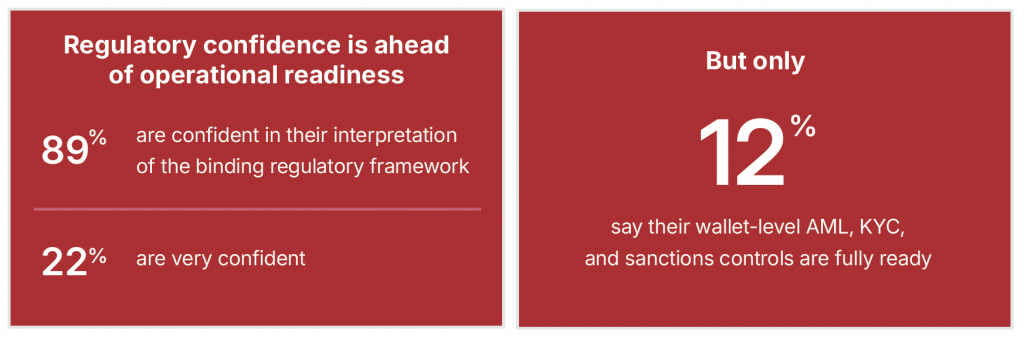
Our research also discovered that the readiness gap extends to controls within the new regulations. Nearly 9 in 10 (89%) are confident in their interpretation of the regulatory controls in their region, over a fifth (22%) are even “very confident”. Surprisingly, this doesn’t extend to the controls; only one in ten (12%) say their wallet-level AML (Anti-Money Laundering), KYC (Know Your Customer), and sanctions controls are fully ready to support stablecoin payments.
That’s an interesting, but understandable, disparity between the two levels of readiness. Banks are confident in their understanding of the regulations. MiCA is in force in the EU, the GENIUS Act is US law with rules still being finalised and the UK has published its own regime. This helps to drive adoptions across each region.
The controls that work within these binding frameworks are newer, so it makes sense that not every bank is ready yet. The majority (59%) describe their controls as “mostly ready”. In reality, these banks may be less ready than they think. In sanctions and financial crime, readiness is a binary state. Partial coverage doesn’t equal partial risk. Those describing themselves as “mostly ready” may be underestimating the remaining level of exposure.
For decades, screening has been built around names, accounts, and countries. On a blockchain, banks are screening a wallet address, often without knowing who’s behind it. That wallet’s history matters as much as the payment itself. Screening has to run 24/7 and happen within seconds of the payment being made. That makes it a new control, not an upgrade of an old one.
Why the systems aren’t ready yet
To support digital money, banks plan to make big changes. Over half (57%) of respondents expect to build or upgrade existing infrastructure, with a further fifth (21%) expecting to connect through a partner network. Among those expecting to change their infrastructure, six in ten (61%) expect their payments hub to be affected, while a similar number (60%) foresee changes to their core banking system or ledger.
Integrating these new rails into a bank’s infrastructure isn’t a simple or quick process. It means significant changes across:
Ledger integration
Liquidity management and prefunding
On-chain and off-chain reconciliation
Wallet-level compliance controls
Operating hours and exception management
Domestic and cross-border payment connectivity
Interoperability with account-based and ISO 20022 rails
Most of these changes meet in one place: the payments hub. It must pick the right rail for each payment, convert between them, settle, reconcile, and apply the same controls across all of them. The hub stops being a router and becomes an orchestration layer.
Underestimated costs
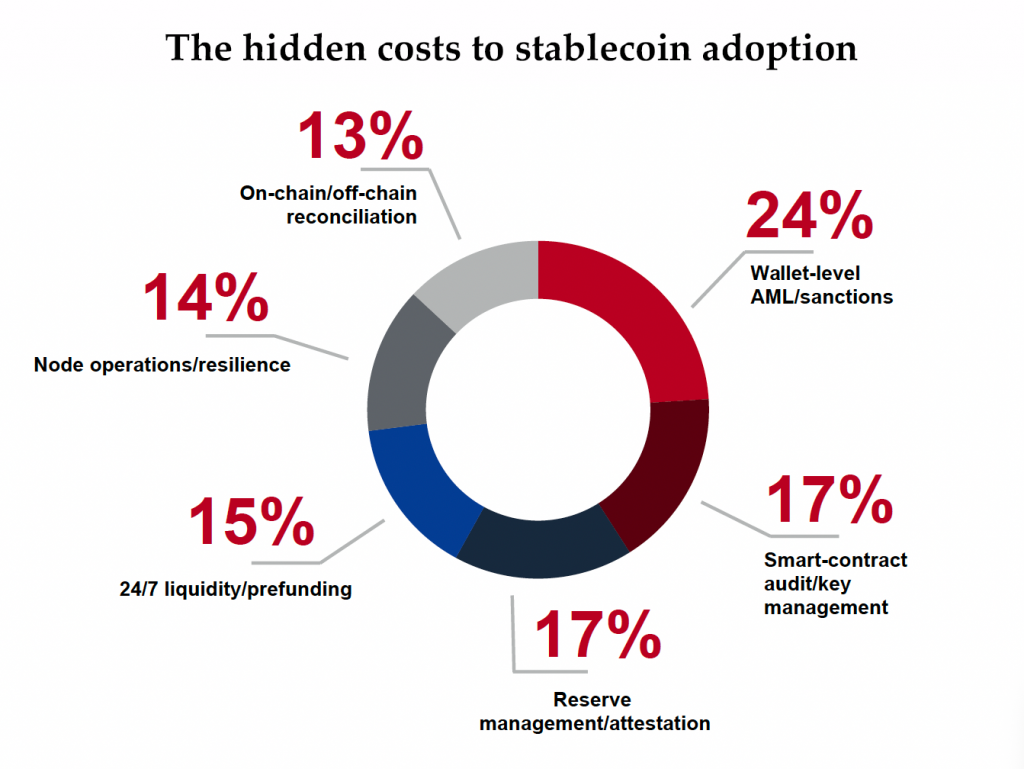
Not one of the 300 respondents said that they completely understand the costs of running digital money rails. In many areas – such as 24/7 liquidity/prefunding, on-chain/off-chain reconciliation, and reserve management/attestation – banks think they are underestimating how much it will cost to run digital rails. It may not be a coincidence that only around one in ten (12%) have AML, KYC, and sanctions controls ready, and more respondents (24%) selected it as an underestimated or hidden cost than any other option.
The answer shifts depending on the market. In the US, 24/7 liquidity and prefunding is the top hidden cost (25%) ahead of reserve management (20%). This suggests that the banks there expect funding payments round the clock, across several settlement pools, is where the costs will start to add up.
Not so long ago, none of this needed pricing in at all. Factors such as wallet-level compliance or on-chain/off-chain reconciliation weren’t line items on a budget. It means banks now have to cost infrastructure for rails that only recently became part of board-level conversations. This explains why some systems aren’t yet ready and why the costs of these unfamiliar digital assets aren’t fully understood.
Ready to move, not yet ready to scale
Six out of ten banks (62%) of banks are planning or piloting their own-issued stablecoins. Only one in ten (10%) are operating one. It’s a similar picture with tokenized deposits (60% vs 9%). Confidence in understanding the rules hasn’t translated into controls being ready, and banks still don’t fully understand how much being digital-money-ready will cost.
The real test isn’t completing the pilot phase. It’s supporting a viable end-to-end business flow, without separate systems, fragmented controls, or unsustainable costs. Right now, much of the industry isn’t there. Yet.
Download our digital assets report
Understanding digital money and being ready are two different things. Delve into the data behind the readiness gap – get your copy here.