Within the United States, RTP and FedNow let you send a dollar payment in seconds. Any day. Any hour. These instant rails keep the same hours as the dream customer service phone line – they’re available around the clock, don’t stop at the weekend or take weekday holidays off.
The moment that same dollar is about to cross the border, things start to slow down. It’s no longer moving via FedNow or RTP, so business-day cut-offs, holidays, and weekend closures are involved. Settlement systems like CHIPS and Fedwire can turn a same-day transfer into a multi-day delay.
On 23 September, the Federal Reserve confirmed that the FedNow Service will support cross-border transactions. RTP is moving in the same direction. The Clearing House has already updated its rules to allow “one-leg-out” transactions and is targeting a pilot in the first half of 2027.
Why are these important milestones?
The dollar is behind more than 50% of international payments. When it slows down, businesses and banks across the world wait days for payments to arrive. If RTP and FedNow payments can settle instantly domestically, there needs to be a way to maintain that speed when a payment leaves the US.
Two rails, two use cases
In November, it will be nine years since The Clearing House (TCH) launched the US’s first instant payment rail RTP. FedNow recently celebrated its third anniversary too. These rails carried more than 455 million transactions combined in 2025 alone.
Over the three years they’ve co-existed, RTP and FedNow have been competing products, vying for market dominance. And on the surface, FedNow has a greater reach, while RTP leads on traffic. Given its six-year headstart, that’s hardly surprising. It now carries around 98% of all bank-to-bank instant transfers in the US, at a value of $1.3 trillion in 2025.
98% to 2% seems to be quite conclusive. But the two rails aren’t competing for the same traffic. FedNow’s average payment in 2025 was $101,435 (8.4 million payments divided by $853.4bn), compared to $2,900 on RTP ($442 million payments divided by $1.3 trillion). In Q1 2026, $271 billion moved via FedNow. Despite processing far fewer transactions, the size of each is clearly far greater.
So, we shouldn’t see the two rails as being in competition. RTP and FedNow aren’t really contending for the same traffic. TCH’s service has grown as a high-volume retail infrastructure and still carries the bulk of instant payment volume. FedNow has found its place in low-volume, high-value corporate rail.
With both instant payment services clearing retail and corporate payments in seconds and running 24/7, why are US cross-border payments still restricted by business windows?
Many of those transactions would have at least one leg through US wholesale settlement systems CHIPS and Fedwire Funds Service. Today, both only operate from Monday to Friday. Fedwire, for instance, runs for 22 hours a day. The issue here is operating days, not operating hours.
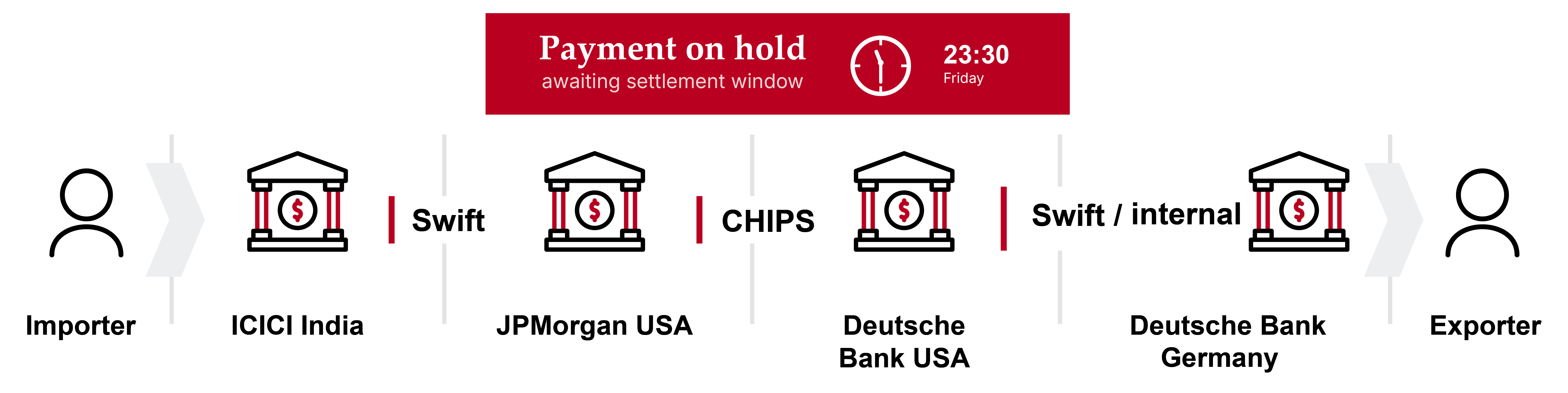
Let’s consider what this means in real-world scenario. For instance, an Indian company agrees to import power tools from a company in Germany and pay in USD. The German firm sets strict clauses on payment timelines and penalties for any delays.
Once the payment is initiated, the importer must try to ensure there are no bottlenecks, including any cut-off breaches in the correspondent banking chain. So, any delay may cause the payment to arrive at a US bank at the weekend, making a hold up of at least two days a real possibility before the final settlement. The same issue may also occur if this happens outside of the rails’ operating hours. The restrictions of the US settlement system could be responsible for a much higher bill for the Indian company.
The Federal Reserve is modernizing. From 2028, at the earliest, Fedwire Funds and the National Settlement Service will run six days a week, Sunday to Friday, including weekday holidays. But this still means no transfers on a Saturday, daily hours won’t change and participation is voluntary.
So, a payment landing at a US bank on a Friday evening can still take a weekend to clear. Is this enough for the currency that dominates global trade?
Lessons from Europe
The Eurozone’s OCT inst scheme can be a blueprint for the US rails. It lets the Euro leg of cross-border transfers worth up to €100,000 settle through the SEPA infrastructure 24/7/365. No cutoffs, holidays or weekend delays.
The benefits go beyond just speed. It reduces the misuse of the rails that risked screening and compliance issues. But there are structural differences, which will impact how the US can follow Europe’s example.
Governance
SEPA sits under a single rulebook owner, whereas FedNow and RTP operate with different mandates. TCH is a bank-owned, private entity and the Fed is both an operator and regulator. This means no single body can create a US ‘one-leg-out’ rule book that both operators will abide by.
Data standards
Europe’s instant retail payment scheme has run on ISO 20022 since its launch. The legacy formats were retired in August 2014 in the euro area and 2016 for the wider SEPA area. For wholesale transfers the gap is narrower. Europe’s TARGET2 migrated in March 2023 and Fedwire was the last US scheme to follow suite in July 2025. RTP and FedNow have been ISO-native since their launch. So data standards will not act as a blocker.
Scheme agility
SCT (SEPA credit transfer) and RTP both went live within weeks of each other in November 2017. Europe moved first on cross-border payments, launching OCT Inst in November 2023. It’s not all been plain sailing since. The EPC (European Payments Council) has warned participants about misuse of the SCT and SCT Inst for one-leg out payments, and adoption has been slower than hoped – most traffic isn’t yet flowing on the scheme.
Europe has shown that you can solve the design problem, but also that having a scheme rulebook doesn’t move volume by itself.
3 things you should do now
1. Calculate the cost of weekend delays
Look at your USD cross-border flows and work out what sits in the correspondent chain across weekends and US holidays: how much value sits in there? What are the liquidity buffers needed to fund it? How much late-payment and penalty fees are your corporate clients paying? That figure will tell you how important it is to start prioritizing cross-border instant payments.
2. Read the Fed’s 2028 commitment carefully
Fedwire Funds and NSS (National Settlement Service) are planning to extend the service. This means it will be running 22×6, including Sunday and weekday holidays by 2028 or 2029. So there will be extra operating days but not 24-hour coverage, Saturday still isn’t covered and participation won’t be mandatory. Additionally, your own correspondent may choose not to switch on extended hours. If your plan is for always-on US dollar settlement in 2028, it’s worth checking whether everyone in your network has the same idea.
3. Find out what happens beyond the domestic leg
The Fed’s proposal in April 2026 to allow FedNow to support cross-border payment has moved from consultation to action. This will enable a group of early-adopter institutions to test new message formats for the US leg, before it’s rolled out to all FedNow participants.
Similarly, TCH’s decision to allow RTP for cross-border transactions has its own pilot program — with BNY among the first banks signed up. On current timelines, RTP could beat FedNow to market.
But on both rails, the model is the same: only the US leg moves on the instant rail. The international leg still runs through correspondent banking.
Fixing both legs of the journey
There are different ways to take US domestic instant payment rails international. You can build a new scheme with a new rulebook, cross-currency rules and foreign banks joining RTP or FedNow as members. It’s the route Europe went down with OCT Inst.
But, for now, the US is doing it differently. It’s leaving the plumbing alone and letting existing relationships carry the traffic. A foreign bank doesn’t join any new schemes and keeps the US correspondent bank it already banks with (that’s already an RTP or FedNow member). The instant rail will only touch the US leg and the international leg runs through the same correspondent arrangement as before.
This is a sensible arrangement, but it’s a workaround. Putting the US leg on an instant rail doesn’t remove the correspondent banks slowing down payments, it speeds up one leg.
But that speed brings its own demands. Real-time payments only work at scale if data, processes and governance can keep up. Once settlement moves in seconds, there is much less time for screening, controls and exceptions to be handled manually. Banks therefore need better data, aligned processes and continuous monitoring that can operate at the speed of the payment itself.
How much longer can the currency behind around 80% of global trade finance settle six days a week through a chain of other banks? Stablecoin issuers, Swift’s shared ledger and card networks are building settlement that runs 24×7. A treasurer who can reliably settle a payment on Friday night won’t care about which rail it crossed. What matters is not waiting until Monday.
How RedCompass Labs can help
We have helped institutions launch and scale instant payments in more than 20 markets, including SEPA Instant, FedNow, RTP, Pix and UPI, and we’ve worked with Payments Canada on Canada’s Real-Time Rail ahead of its Q4 2026 launch. We’ve seen much of this roadmap before. We’ve helped it land somewhere else, navigating the same pitfalls.
Whether you are already live, connecting directly, or joining through a sponsor or service provider.